LiFePO4 vs NMC Power Stations: Which Battery to Choose
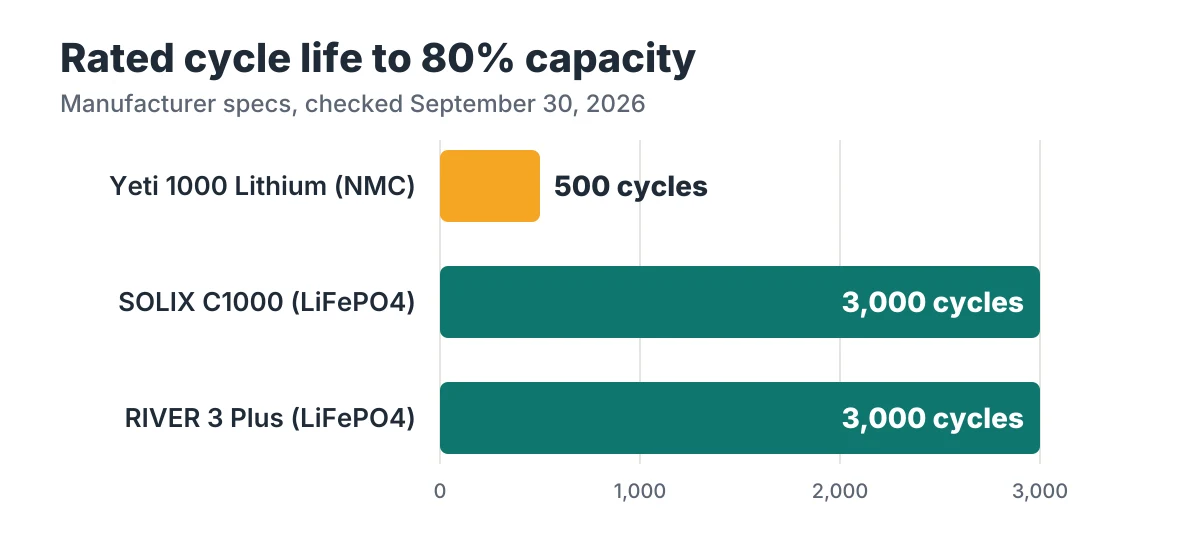
For most people, a LiFePO4 (lithium iron phosphate, also called LFP) power station is the better buy. The models we checked are rated for 3,000 charge cycles to 80% capacity, versus 500 for an NMC model. LFP cells also react less violently if they ever fail. NMC cells store more energy per pound, but that advantage doesn’t always show up in the finished product: one of the LFP stations we compared weighs less per watt-hour than the NMC one.
Almost every portable power station uses one of two lithium-ion chemistries. NMC (nickel manganese cobalt, sometimes written NCM) was common in earlier models, such as Goal Zero’s Yeti Lithium line. LiFePO4 is used in the three recent stations we’ve checked for our guides: the EcoFlow RIVER 3 Plus, the Anker SOLIX C1000 and the EcoFlow DELTA 3 Max Plus. Here’s how they compare on the things that matter when you buy one.
Cycle life: the biggest difference
A cycle is one full charge and discharge. Manufacturers rate how many cycles a battery can do before it drops to a set share of its original capacity, usually 80%.
| Model | Chemistry | Capacity | Rated cycle life | Weight | Wh per lb |
|---|---|---|---|---|---|
| Goal Zero Yeti 1000 Lithium | NMC | 1,045 Wh | 500 cycles to 80% | 40 lb | 26.1 |
| Anker SOLIX C1000 | LiFePO4 | 1,056 Wh | 3,000 cycles to 80% | 28.44 lb | 37.1 |
| EcoFlow RIVER 3 Plus | LiFePO4 | 286 Wh | 3,000 cycles to 80% | 10.4 lb | 27.5 |
Specs checked on September 30, 2026 from the manufacturers’ pages. These are examples, not recommendations.
What that means in practice:
- Daily use (off-grid living, a van, a daily solar cycle): 500 cycles is about 1.4 years of full daily cycles; 3,000 cycles is about 8 years. Here LiFePO4 is the clear choice.
- Occasional use (a few weekends a year, backup for rare outages): at one full cycle a week, even 500 cycles would take almost 10 years. Cycle life matters much less, although batteries also age with time. Check the warranty length too: Anker lists 5 years for the SOLIX C1000.
Cycle ratings are measured under specific lab conditions. Goal Zero, for example, states its rating at a 1C discharge, full charge and discharge, and 25°C. Your results will vary, and ratings from different brands aren’t always measured the same way.
Weight and size
At the cell level, NMC stores more energy per kilogram. In a study published in the Journal of Energy Chemistry (2020), with a co-author from Oak Ridge National Laboratory, the LFP cell tested stored 146 Wh/kg, while the NMC cells stored 202 to 253 Wh/kg.
At the level of a finished power station, the picture is less clear. The case, inverter, cooling and design generation all add weight. In our table, the LFP SOLIX C1000 holds 37.1 Wh per pound, more than the NMC Yeti 1000 Lithium at 26.1 Wh per pound. Compare the actual specs of the models you’re considering instead of assuming the chemistry decides the weight.
Safety
No lithium battery is risk-free. Every power station relies on its battery management system to prevent overcharging, overheating and short circuits. The chemistry matters most if something goes wrong anyway.
The same 2020 study pushed large cells of both chemistries into overcharge until they failed:
- When failure happened, LFP was milder. The LFP cell reached a lower maximum temperature and released smoke without flames. All the NMC cells ejected flames and ignited.
- But LFP didn’t tolerate overcharge better. The LFP cell reached thermal runaway earlier in the overcharge test. The authors rate NMC cells as better at tolerating overcharge, and LFP cells as less hazardous once runaway happens.
- Among the NMC cells, those with more nickel were more hazardous when they failed.
In other words, LFP is not “fireproof”, but its failures in this test were less violent. That’s a real advantage for a device you keep indoors or in a vehicle.
Safety: Whatever the chemistry, use the charger and cables the manufacturer approves, keep the station within the temperatures in its manual, don’t cover its vents while it’s working, and stop using any battery that is swollen, damaged or smells of chemicals. Never open or modify the battery pack.
Cold weather
Both chemistries have limits in the cold, and the station’s manual is what counts. The LFP stations in our table list charging only from 32°F (0°C) up. Goal Zero lists an operating range of 32–104°F (0–40°C) for the NMC Yeti 1000 Lithium. If you’ll use a station in winter, check its separate charging and discharging ranges, and keep it warmer than the outside air when you can. Our camping guide covers this for trips.
Which should you choose?
| If you… | Lean toward |
|---|---|
| Cycle the battery daily or several times a week | LiFePO4 |
| Keep it indoors or in a vehicle and want the mildest failure behavior | LiFePO4 |
| Want the most energy in the lightest pack and use it rarely | Compare specific models; NMC cells are denser, but finished stations vary |
| Already own an NMC station that works | Keep using it; there’s no need to replace a working unit |
Whichever you pick, size it for what you’ll actually run: our sizing guide walks through the math, and the runtime calculator tells you how long a given capacity lasts. To see where our numbers come from, read How We Research.