
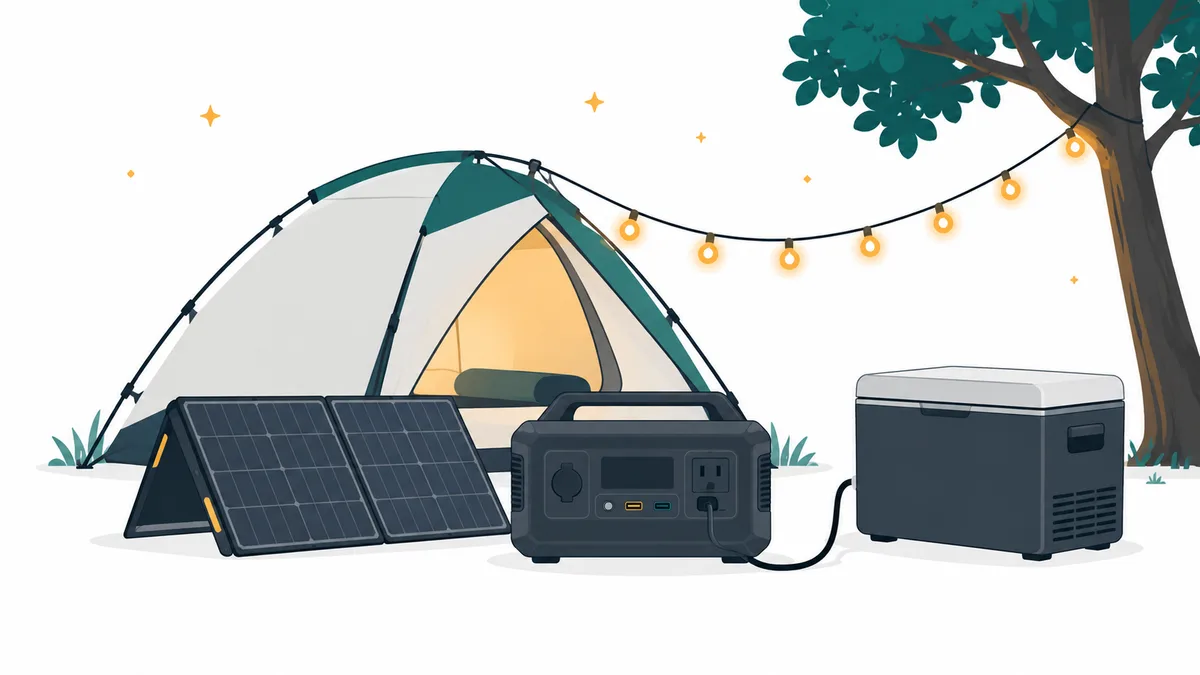
Portable Power Station for Camping: How to Choose
Start from what you’ll power and how long you’ll go without recharging. In our examples, phones, lights and a laptop need about 340 Wh per day. Add a 12V fridge and satellite internet and you need about 760 Wh if you can recharge every day (a 1,000 Wh class station), or about 2,300 Wh for three days without recharging. Run the fridge from the station’s 12V car port, not the AC outlet, to waste less energy.
A portable power station is a large rechargeable battery with AC outlets, USB ports and a 12V car port. At a campsite it does the job of a small generator, but it runs silently and produces no exhaust. The trade-off is that it only stores a limited amount of energy, so choosing the right size matters more than choosing the right brand.
Step 1: Match the station to your kind of camping
| Kind of trip | What you usually power | What matters most |
|---|---|---|
| Tent or car camping, 1–2 nights | Phones, lights, maybe a laptop | Low weight, enough USB ports |
| Long weekend with a 12V fridge | Fridge 24 hours a day, plus small electronics | Capacity (Wh) and a 12V car port |
| Van or overland trips | Fridge, laptop, satellite internet, lights | Capacity plus a way to recharge daily |
| Backpacking | Phone, headlamp, GPS | A power station is too heavy; a small USB power bank fits better |
Weight grows with capacity. For example, the 286 Wh EcoFlow RIVER 3 Plus weighs 10.4 lb, and the 1,056 Wh Anker SOLIX C1000 weighs 28.44 lb (specs checked on September 26, 2026 from the manufacturers’ pages). If you’ll carry the station from the car to a walk-in site, weigh that against the extra runtime.
Step 2: Add up what you’ll use per day
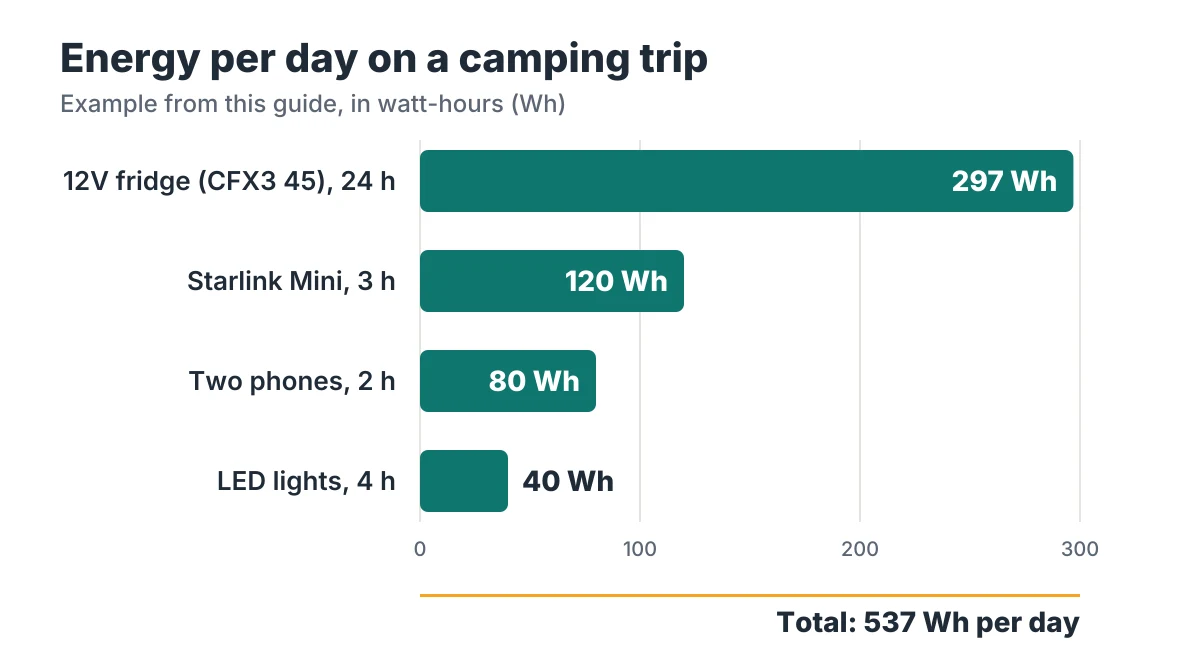
Energy per day is simply watts × hours for each device. Here is a realistic car-camping day with a 12V fridge:
| Device | Watts | Hours/day | Wh/day |
|---|---|---|---|
| 12V fridge, Dometic CFX3 45 (average draw on a 90°F day) | 12.4 | 24 | 297 |
| Starlink Mini (upper end of its 25–40 W average) | 40 | 3 | 120 |
| Two phones charging (example: 20 W adapters) | 40 | 2 | 80 |
| LED camp lights (example label value) | 10 | 4 | 40 |
| Total | 537 |
The fridge figure comes from Dometic’s published spec: 1.03 Ah per hour at 12V, measured with a 32°C (90°F) ambient temperature and 4°C (39°F) inside. That’s 1.03 × 12 = 12.4 W on average, or about 297 Wh a day. Its compressor draws more while it runs (the rated DC input is 8.2 A), but it cycles on and off. On cooler days it will use less. A household fridge is a different case, with much higher consumption; we cover it in Can a Portable Power Station Run a Refrigerator?
Bringing a CPAP? With its humidifier and heated tube, ResMed’s measurements put it at about 272 Wh per night, more than the Starlink, phones and lights in this table combined. See Portable Power Station for CPAP before you size your station.
Step 3: Decide how many days between recharges
capacity needed (Wh) = Wh per day × days ÷ 0.85, plus a margin
Three days, no recharging: 537 × 3 ÷ 0.85 = 1,894 Wh, plus 20% = about 2,270 Wh
Recharging every day: 537 ÷ 0.85 = 632 Wh, plus 20% = about 760 Wh
The 0.85 covers conversion losses; it’s the same planning assumption we use in our runtime calculator. The 20% margin is our rule of thumb for battery aging, temperature and surprises, not a measured value. For the full method with more examples, see What Size Portable Power Station Do I Need?
That gap is the key decision for camping: a way to recharge at camp can cut the battery size you need by about two thirds in this example.
Step 4: Plan how you’ll recharge at camp
- Solar panels: the most common option for multi-day trips. A panel’s real output depends on sun, season, weather and angle, so plan for less than its rated watts. Check the station’s maximum solar input: for example, the RIVER 3 Plus accepts up to 220 W, and the SOLIX C1000 up to 600 W (11–60 V).
- Your car while driving: convenient on road trips. EcoFlow lists car charging for the RIVER 3 Plus at up to 220 W (11–55 V), 0–100% in 3.3 hours. The real rate depends on your vehicle’s outlet, so check both manuals.
- Campground hookups: if your site has an outlet, the station recharges from AC like it does at home.
Step 5: Check the features that matter outdoors
- A 12V car port: 12V fridges and many camping devices run on 12V DC. Plugging them into the car port skips the inverter and its conversion losses. As an example, on the DC side (90% efficiency, our planning assumption) the SOLIX C1000 could keep the CFX3 45 running for about 77 hours, a little over 3 days, on a hot day.
- Charging temperature: both stations mentioned here list charging only from 32°F (0°C) and up. The RIVER 3 Plus lists discharge from 14°F to 113°F; the SOLIX C1000 from -4°F to 104°F. On cold trips, check the forecast against those ranges and let the station warm up before charging it.
- Water and dust: the RIVER 3 Plus lists an IP54 rating for its battery pack, which is splash resistance, not waterproofing. Keep any station out of rain and off wet ground.
- Battery chemistry: the three stations we checked for our guides use LiFePO4 (lithium iron phosphate) cells. The RIVER 3 Plus, for example, lists 3,000 cycles to 80% capacity.
- Enough output for what you’ll plug in: a kettle or coffee maker needs a station rated above the appliance’s watts. See the output section in our sizing guide.
Quiet hours and campground rules
Many campgrounds restrict fuel generators. In Yosemite, for example, generators are allowed only from 7 to 9 a.m., noon to 2 p.m. and 5 to 7 p.m., and quiet hours run from 10 p.m. to 6 a.m. A battery power station makes no engine noise, which is a big part of its appeal at campsites. Rules vary by park and campground, so check the specific rules where you’re staying.
Safety: If you also bring a fuel generator, the U.S. Consumer Product Safety Commission warns never to use one inside enclosed spaces, even with doors or windows open, and to run it outdoors at least 20 feet from buildings with the exhaust pointed away. Carbon monoxide can kill in minutes; never run one near a tent or camper opening. For the power station itself, follow the manual’s temperature limits, keep its vents clear and don’t cover it while it’s working.
Quick picks by trip
Based on the numbers above:
| Trip | Starting point |
|---|---|
| Phones, lights and a laptop (60 W adapter, 2 h/day) | About 340 Wh per day |
| Long weekend with a 12V fridge, recharging daily (solar or driving) | About 1,000 Wh |
| Long weekend (3 days) with a 12V fridge and no recharging | About 2,300 Wh |
| Anything with a kettle, coffee maker or hair dryer | Check rated output (W) first |
Your own device list is what decides the size. Put it in the runtime calculator before you buy, and read How We Research to see where our numbers come from.