Best Portable Power Station for Camping: Picks by Specs
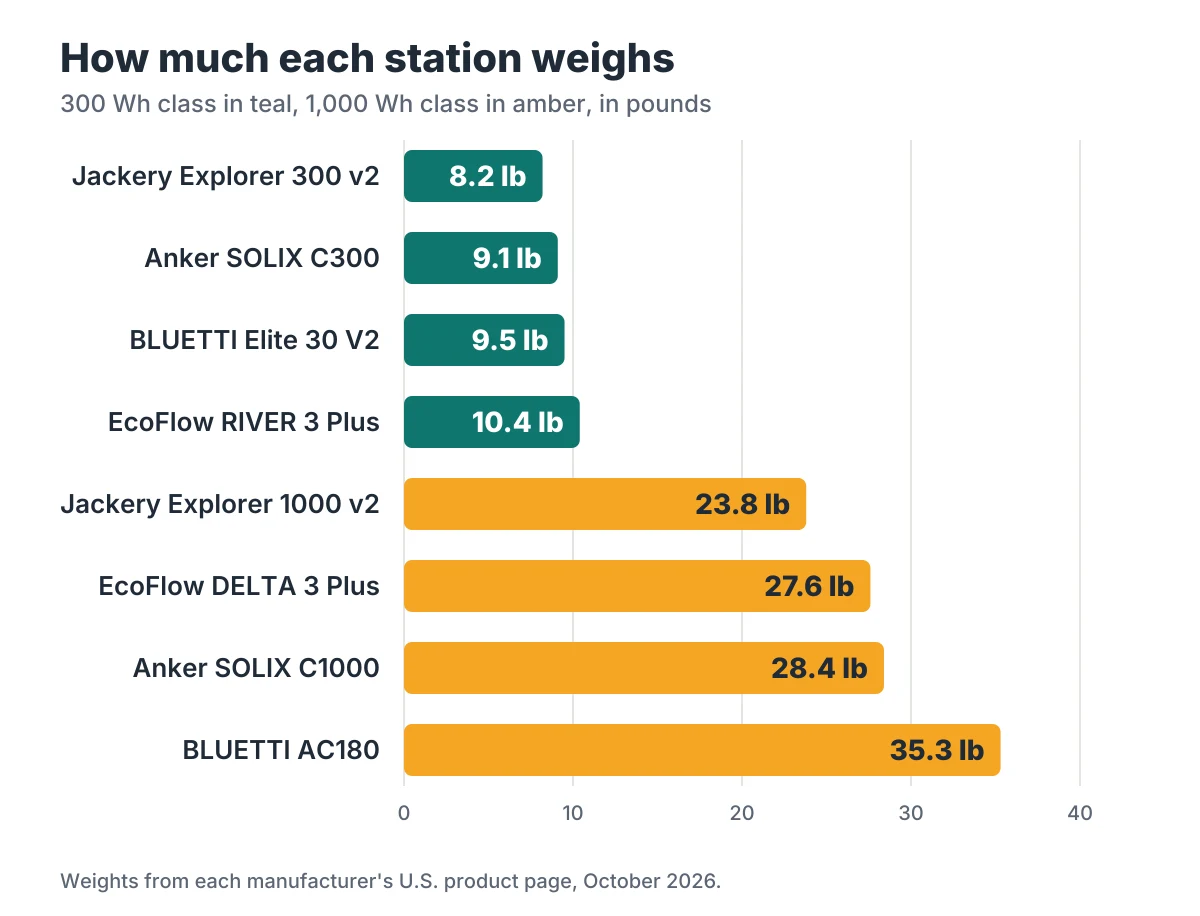
There’s no single best portable power station for camping: the right one depends on what you power and how long you go without recharging. Based on official specs: for phones, lights and a laptop on a weekend, a light 300 Wh station such as the Jackery Explorer 300 v2 (8.2 lb) is enough. For a 12V fridge with daily recharging, look at the 1,000 Wh class, where the Jackery Explorer 1000 v2 is the lightest (23.8 lb) and the EcoFlow DELTA 3 Plus takes the most solar (1,000 W). For cold nights, check discharge ratings: the Anker and BLUETTI models list use down to -4°F.
How we picked: we don’t physically test products and no brand paid for a place on this page. The picks come only from manufacturers’ official specs, checked in October 2026 for our 300 Wh and 1,000 Wh comparisons, applied to the camping needs in our camping guide. There are no affiliate links on this page. See How We Research.
Step 1: pick the size from your trip
The numbers come from our camping guide:
| Your trip | Energy needed | Class to look at |
|---|---|---|
| Phones, LED lights and a laptop, 1–2 nights | About 340 Wh per day | 300 Wh class (a full day of that list needs recharging or a bigger station) |
| Long weekend with a 12V fridge, recharging daily (solar or driving) | About 760 Wh | 1,000 Wh class |
| 3 days with a 12V fridge and no recharging | About 2,300 Wh | 2,000 Wh class: see our 2,000 Wh comparison |
A 300 Wh station gives about 245 Wh from its AC outlets (our 0.85 allowance for inverter losses): enough for phones, lights and a few hours of laptop, or about 21 hours of a 12V compressor fridge on a hot day from a 12 V port, on models that have one (the Jackery and Anker pages list a 12 V car outlet).
Step 2: the camping specs that matter
| Model | Capacity | Weight | Output | Max solar | Lowest use temperature |
|---|---|---|---|---|---|
| Jackery Explorer 300 v2 | 288 Wh | 8.2 lb | 300 W | Not clearly listed | 14°F |
| Anker SOLIX C300 | 288 Wh | 9.1 lb | 300 W | 100 W (11–28 V) | Not listed |
| BLUETTI Elite 30 V2 | 288 Wh | 9.5 lb | 600 W | 200 W (12–28 V) | -4°F |
| EcoFlow RIVER 3 Plus | 286 Wh | 10.4 lb | 600 W | 220 W | 14°F |
| Jackery Explorer 1000 v2 | 1,070 Wh | 23.8 lb | 1,500 W | 400 W (12–60 V) | 14°F |
| EcoFlow DELTA 3 Plus | 1,024 Wh | 27.6 lb | 1,800 W | 1,000 W (11–60 V) | Not found |
| Anker SOLIX C1000 | 1,056 Wh | 28.4 lb | 1,800 W | 600 W (11–60 V) | -4°F |
| BLUETTI AC180 | 1,152 Wh | 35.3 lb | 1,800 W | 500 W (12–60 V) | -4°F |
Specs from each manufacturer’s U.S. product page, checked on October 21 and 29, 2026. “Lowest use temperature” is the bottom of the listed discharge range. All of these charge only from 32°F (0°C) up where the page lists it, so a station that can run at -4°F still can’t be recharged until it warms above freezing.
Picks by kind of trip
Weekend tent or car camping: Jackery Explorer 300 v2
At 8.2 lb it’s the lightest station we’ve checked in the 300 Wh class, with 300 W of output for phones, lights, a laptop or a CPAP. If you need 600 W (for example, a small TV and a laptop at once), the BLUETTI Elite 30 V2 (9.5 lb) and the EcoFlow RIVER 3 Plus (10.4 lb) are the 600 W options; the RIVER 3 Plus also takes the most solar in this class, 220 W.
A 12V fridge with daily recharging: Jackery Explorer 1000 v2 or EcoFlow DELTA 3 Plus
For about 760 Wh a day, a 1,000 Wh class station fits. The Explorer 1000 v2 is the lightest at 23.8 lb. If you’ll rely on solar, the DELTA 3 Plus accepts up to 1,000 W of panels against the Jackery’s 400 W; that only pays off with several panels. Run the fridge from the 12 V car port, which all four list, to skip the inverter’s losses.
Cold-weather camping: Anker SOLIX C1000, BLUETTI AC180 or Elite 30 V2
These list use down to -4°F; the Jackery and EcoFlow models list 14°F. That matters for overnight use in a cold car or tent. Remember that charging still needs 32°F or more: keep the station inside the car or tent, insulated, before you plug in a panel.
Rain and dust: EcoFlow
EcoFlow lists an IP54 rating for the RIVER 3 Plus battery pack and IP65 for the DELTA 3 Plus battery pack. These protect against splashes and dust, not immersion, and the other pages don’t list a rating. Keep any station out of rain and off wet ground.
Three days off-grid with a fridge: the 2,000 Wh class
About 2,300 Wh is more than any station on this page holds. See 2000 Watt Power Stations Compared, where the lightest options weigh 39.5 to 41 lb, or plan a way to recharge.
Before you buy
- Check the 12 V port if you’ll run a 12V fridge: it’s the most efficient way to power it.
- Match your panels to the solar input: watts, voltage range and connector. Two of the small stations accept only up to 28 V, which rules out many larger folding panels. Our charging guide explains how to check.
- Check campground rules. Some restrict fuel generators; a battery station makes no engine noise. Our camping guide has an example.
Safety: Keep the station within the temperatures in its manual, out of rain and off wet ground, with its vents clear. Never run a fuel generator, grill or heater inside a tent, camper or car: carbon monoxide can kill in minutes.