1000 Watt Power Stations Compared: 4 Models, Real Specs
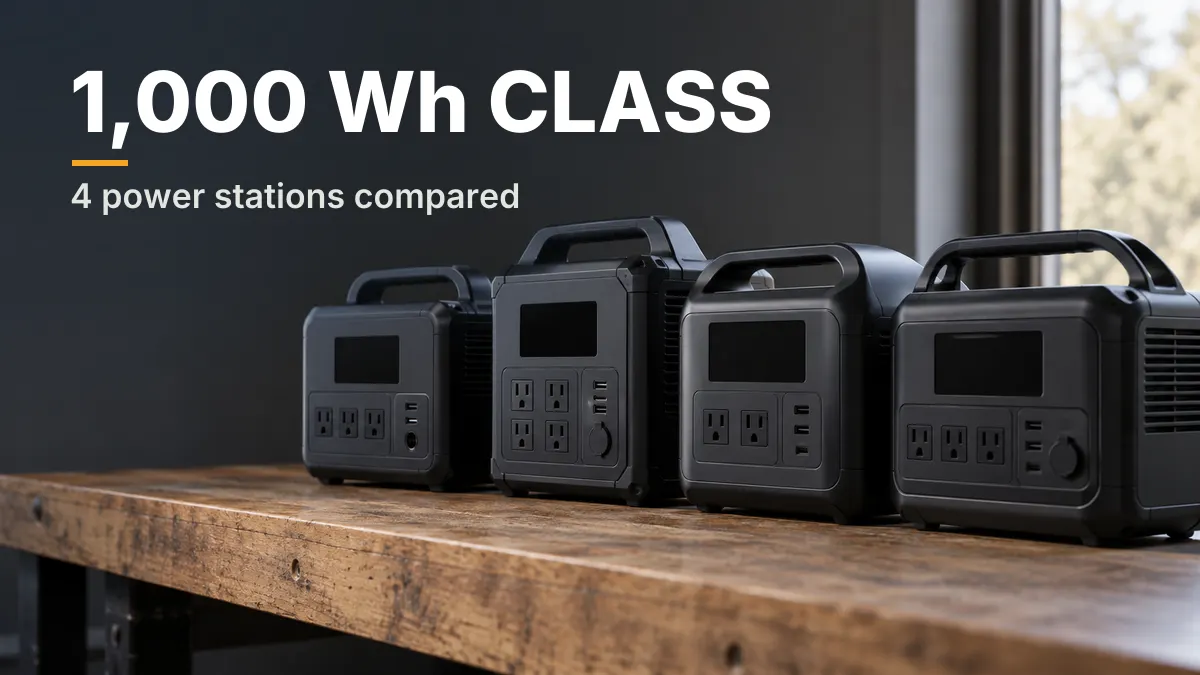
Four popular 1,000 Wh class stations, compared on their official specs: the Anker SOLIX C1000, EcoFlow DELTA 3 Plus, Jackery Explorer 1000 v2 and BLUETTI AC180. Their capacities are close (1,024 to 1,152 Wh), so they all run a 100 W load for about 9 to 10 hours. The real differences are elsewhere: the Jackery is the lightest, the DELTA 3 Plus charges fastest from the wall and from solar, the AC180 holds the most energy but is the heaviest, and the C1000 sits in the middle on most lines.
How we compared: we don’t physically test products and no brand paid for a place on this page. Every figure comes from the manufacturer’s official product page, checked on October 21, 2026. There are no affiliate links on this page. See How We Research.
First: “1000 watt” can mean two things
People search for a “1000 watt power station” meaning one of two specs:
- About 1,000 watt-hours (Wh) of capacity: how much energy it stores. That’s the class compared here.
- About 1,000 watts (W) of output: how much it can deliver at once.
They’re different numbers. All four stations below hold about 1,000 Wh, and all of them can deliver more than 1,000 W. If the difference isn’t clear, Watts vs Watt-Hours explains it with a real spec sheet. If you only need to charge phones and laptops, see 300 Watt Power Stations Compared for the smaller class.
The specs side by side
| Anker SOLIX C1000 | EcoFlow DELTA 3 Plus | Jackery Explorer 1000 v2 | BLUETTI AC180 | |
|---|---|---|---|---|
| Capacity | 1,056 Wh | 1,024 Wh | 1,070 Wh | 1,152 Wh |
| Rated AC output | 1,800 W | 1,800 W | 1,500 W | 1,800 W |
| Surge | 2,400 W | 3,600 W | 3,000 W | 2,700 W |
| Weight | 28.44 lb | 27.6 lb | 23.8 lb | 35.3 lb |
| Wall charging | 1,300 W max; 80% in 43 min, full in under an hour | 1,500 W; full in 56 min | 15 A max; 1.58 h standard, about 1 h in emergency mode | 1,440 W turbo; 80% in 45 min, full in 1.3–1.8 h |
| Max solar input | 600 W (11–60 V) | 1,000 W (2 × 500 W, 11–60 V) | 400 W (2 ports, 12–60 V) | 500 W (12–60 V, 10 A) |
| Battery | LiFePO4 | LiFePO4 | LiFePO4 | LiFePO4 |
| Rated cycle life | 3,000 to 80% | 4,000 to 80% | 4,000 to 70%+ | 3,500+ (no capacity % listed) |
| UPS switchover | Under 20 ms | 10 ms | Not listed (has a bypass mode) | Pass-through charging; time not listed |
| 12V car outlet | 120 W (12 V, 10 A) | 126 W (12.6 V, 10 A) | 12 V, 10 A | 12 V, 10 A |
| Charging temperature | 32–104°F | Not found on the page | 32–113°F | 32–104°F |
| Warranty | 5 years | 5 years | 3 + 2 years | 5 years |
Specs checked on October 21, 2026 from each manufacturer’s U.S. product page. Manufacturers measure charging times and cycle life under their own conditions, so compare those lines with care. We don’t list prices: they change often.
What the differences mean
Capacity: close enough to call it a tie
The spread is 1,024 to 1,152 Wh. With our usual 0.85 allowance for inverter losses, that’s the difference between about 8.7 and 9.8 hours on a 100 W load, or about 21 to 24 hours on a fridge averaging 41.4 W (the ENERGY STAR top-freezer average from our refrigerator guide). If capacity is your priority, the AC180 has the most; it’s not a big margin.
Output and surge: check the surge for fridges and pumps
Three of the four are rated for 1,800 W continuous; the Jackery for 1,500 W. That matters only for big heating loads, like the 1,480 W microwave in our appliance guide. Surge varies more, from 2,400 W to 3,600 W. It’s the figure that decides whether a refrigerator or a pump starts. Our space heater and microwave guide shows how to check an appliance against these numbers.
Weight: the clearest difference
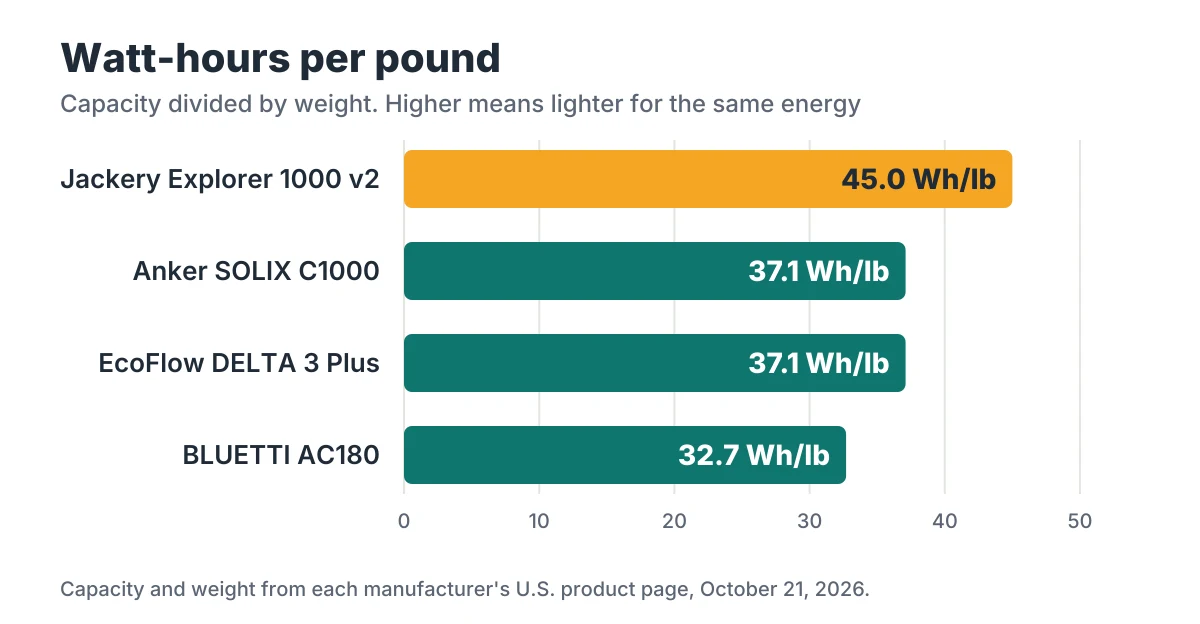
The Jackery stores about 45 Wh per pound; the AC180 about 33. In practice, that’s an 11.5 lb difference between the lightest and the heaviest for similar capacity. If you’ll carry it to a campsite or up stairs, this line matters more than any other.
Charging: from about an hour to about two
From the wall, the DELTA 3 Plus lists a full charge in 56 minutes, the C1000 under an hour, the AC180 1.3–1.8 hours and the Jackery 1.58 hours (about an hour in its emergency mode). Fast wall charging draws a lot of power: at 1,500 W, it takes most of a standard 15-amp household circuit. Our charging guide explains why.
For solar, the gap is wider: 400 W of input on the Jackery against 1,000 W on the DELTA 3 Plus. That only matters if you’ll own enough panels to use it; a single 200 W panel charges all four at roughly the same speed. Check the voltage range too: panels in series must stay under 60 V on all four.
Cycle life: read the fine print
The ratings look different and are measured differently. Two are rated to 80% of original capacity (3,000 cycles for the C1000, 4,000 for the DELTA 3 Plus), the Jackery to 70% (4,000 cycles), and BLUETTI’s page lists 3,500+ cycles without the capacity percentage. A rating to 70% is a lower bar than one to 80%, so the numbers aren’t directly comparable. Cycle life matters most if you’ll charge and drain the station often; for that case, see LiFePO4 vs NMC Power Stations.
Home backup: UPS switchover
If you want the station to sit between the wall and a router or a CPAP and take over in an outage, look for a listed switchover time. The DELTA 3 Plus lists 10 ms and the C1000 under 20 ms. The Jackery lists a bypass mode and the AC180 pass-through charging, but neither page gives a switchover time. See Portable Power Station for Home Backup.
Which one fits which use
Based only on the specs above (for camping in particular, see Best Portable Power Station for Camping):
| If you care most about… | Look at |
|---|---|
| Carrying it (camping, stairs) | Jackery Explorer 1000 v2: lightest, 23.8 lb |
| Fast recharging from the wall or a lot of solar | EcoFlow DELTA 3 Plus: 56 min from the wall, up to 1,000 W solar |
| The most stored energy in this class | BLUETTI AC180: 1,152 Wh, but 35.3 lb |
| A balanced middle option with a listed UPS time | Anker SOLIX C1000: 1,800 W, 600 W solar, under 20 ms switchover |
None of these is the right size for everyone. Before you compare models, work out how much capacity you need with our sizing guide or the runtime calculator: if your list needs 2,000 Wh, no station in this table is enough on its own; see 2000 Watt Power Stations Compared.
Safety: Whatever you buy, use the charger and cables the manufacturer approves, keep the station within the temperatures in its manual, and keep its vents clear. Don’t connect a power station to your home’s electrical panel or wiring yourself; that requires equipment installed by a licensed electrician.