Can a Power Station Run a Space Heater or a Microwave?
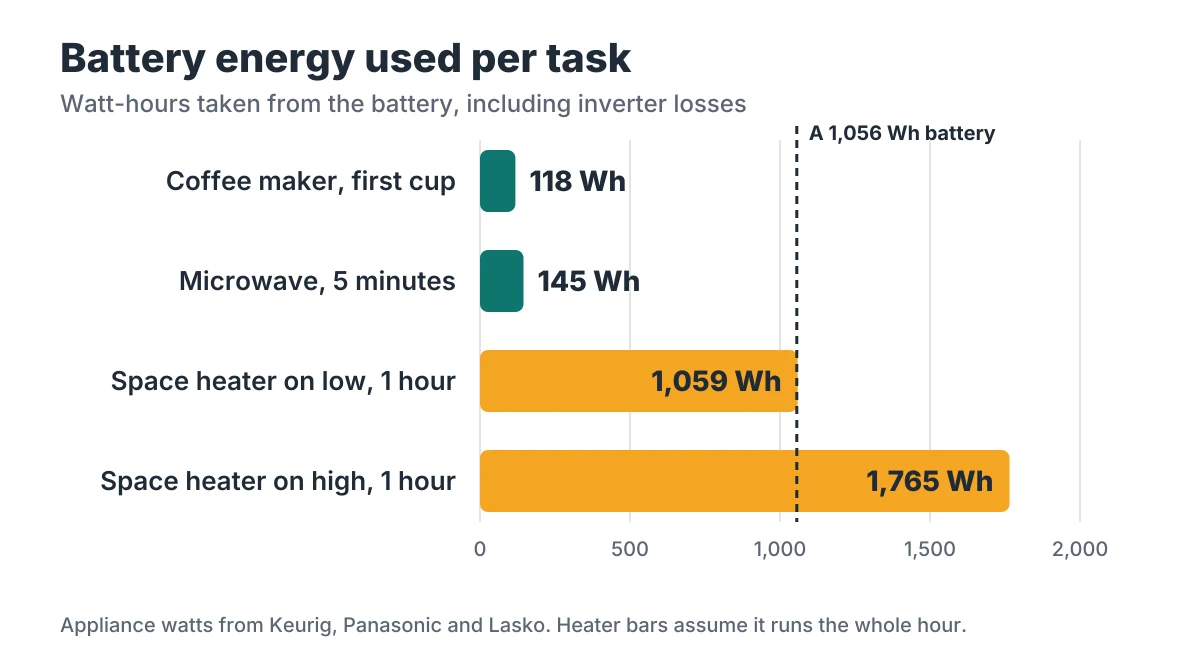
Yes, if the station’s rated output is higher than the appliance’s watts: these three draw about 1,500 W each, so you need a station rated for at least that. The real difference is time. A microwave or a coffee maker runs for minutes and uses little energy: about 120–145 Wh per use. A space heater runs for hours: on high it empties a 1,056 Wh station in about 36 minutes. A power station can make coffee and heat food through an outage; it can’t heat a room.
The watts: what the manufacturers list
| Appliance (example model) | Watts it draws | Source |
|---|---|---|
| Space heater (Lasko 754200) | 1,500 W on high, 900 W on low | Lasko product page |
| Microwave (Panasonic NN-SN686S) | 1,480 W (12.4 A) to deliver 1,200 W of cooking power | Panasonic owner’s manual |
| Single-serve coffee maker (Keurig K-Classic) | 1,500 W peak while heating; 200–400 W when reheating to keep its tank hot | Keurig support |
Specs checked on October 13, 2026. Your models may differ: the number that counts is the input watts on the appliance’s label.
Notice the microwave. The “1,200 W” on the box is cooking power; the oven draws 1,480 W from the outlet to produce it. Size the station for the input figure.
Step 1: Can the station power it?
The appliance’s watts have to be under the station’s rated (continuous) output. Three stations we’ve checked for our guides:
| Station | Rated output | Heater on high (1,500 W) | Microwave (1,480 W) | Coffee maker (1,500 W) |
|---|---|---|---|---|
| EcoFlow RIVER 3 Plus (286 Wh) | 600 W | No | No | No |
| Anker SOLIX C1000 (1,056 Wh) | 1,800 W | Yes | Yes | Yes |
| EcoFlow DELTA 3 Max Plus (2,048 Wh) | 3,000 W | Yes | Yes | Yes |
One at a time. Any two of these appliances together need about 3,000 W (1,500 + 1,480 = 2,980 W). That’s far over an 1,800 W station and right at the limit of a 3,000 W one. Run the coffee maker, then the microwave.
If watts and watt-hours still blur together, Watts vs Watt-Hours sorts them out with a real spec sheet.
Step 2: How much battery does each task use?
This is where the three appliances stop looking alike.
battery energy used (Wh) = watts × hours ÷ 0.85
Microwave, 5 minutes: 1,480 × (5 ÷ 60) ÷ 0.85 = about 145 Wh
Coffee maker, first cup (about 4 minutes of heating): 1,500 × (4 ÷ 60) ÷ 0.85 = about 118 Wh
Space heater on low, 1 hour: 900 ÷ 0.85 = about 1,059 Wh
Space heater on high, 1 hour: 1,500 ÷ 0.85 = about 1,765 Wh
The 0.85 is our planning assumption for inverter losses. The coffee figure uses Keurig’s own numbers: 1,500 W at peak, and about 4 minutes of heating when the brewer starts cold. It’s an upper estimate, because the heater may not draw its peak the whole time.
The microwave: fine for meals
A 1,056 Wh station gives about 36 minutes of total microwave time (1,056 × 0.85 ÷ 1,480), or roughly seven 5-minute sessions. A 2,048 Wh station gives about 70 minutes. For reheating food during an outage, that covers many meals if the microwave is the only big load.
The coffee maker: fine, but turn it off
A first cup costs about 118 Wh, so a 1,056 Wh station covers roughly eight or nine cold starts. The thing to avoid is leaving the brewer on: Keurig says it uses 200–400 W when it reheats to keep its internal tank hot. Brew, then switch it off. The same logic applies to a drip machine’s warming plate: check its label, and pour the coffee into a thermos instead.
The space heater: the wrong job for a battery
| Heater on low (900 W) | Heater on high (1,500 W) | |
|---|---|---|
| 1,056 Wh station | About 1 hour | About 36 minutes |
| 2,048 Wh station | About 1.9 hours | About 1.2 hours |
| Battery needed for 8 hours | About 8,500 Wh | About 14,100 Wh |
These times assume the heater runs continuously. A heater with a thermostat cycles off once the room is warm, so real time can be longer.
Heating a room is simply a lot of energy: one night on low is the capacity of four 2,048 Wh stations. In an outage, a power station is better spent on things that need little energy for a big benefit: the fridge, the internet router, phones, a CPAP. If you want warmth from a battery, look at low-wattage options such as an electric blanket: check the watts on its label and put them in our runtime calculator.
Safety: The U.S. Consumer Product Safety Commission advises keeping space heaters at least 3 feet from drapes, furniture, bedding and anything else that can burn, placing them on a flat, stable surface, and never leaving them on while you sleep or when you leave the room. The CPSC also says to plug a heater directly into a wall outlet, never into an extension cord or power strip; if you run one from a power station, plug it straight into the station and follow both manuals. Never use a fuel-burning heater, grill or generator indoors: carbon monoxide can kill in minutes.
Quick answers for other high-watt appliances
The same two steps work for a kettle, a toaster, a hair dryer or an induction plate:
- Watts on the label under the station’s rated output? If not, it won’t run.
- Watts × minutes of use. Short tasks are cheap; anything that heats for hours is not.
A slow cooker is the in-between case: low watts, but hours of use. Our tailgating guide works through that example.
For a full outage plan with a fridge, router and lights, see Portable Power Station for Home Backup. To size a station for your own list, start with What Size Portable Power Station Do I Need? To see where our numbers come from, read How We Research.