Portable Power Station for Tailgating: What Size You Need
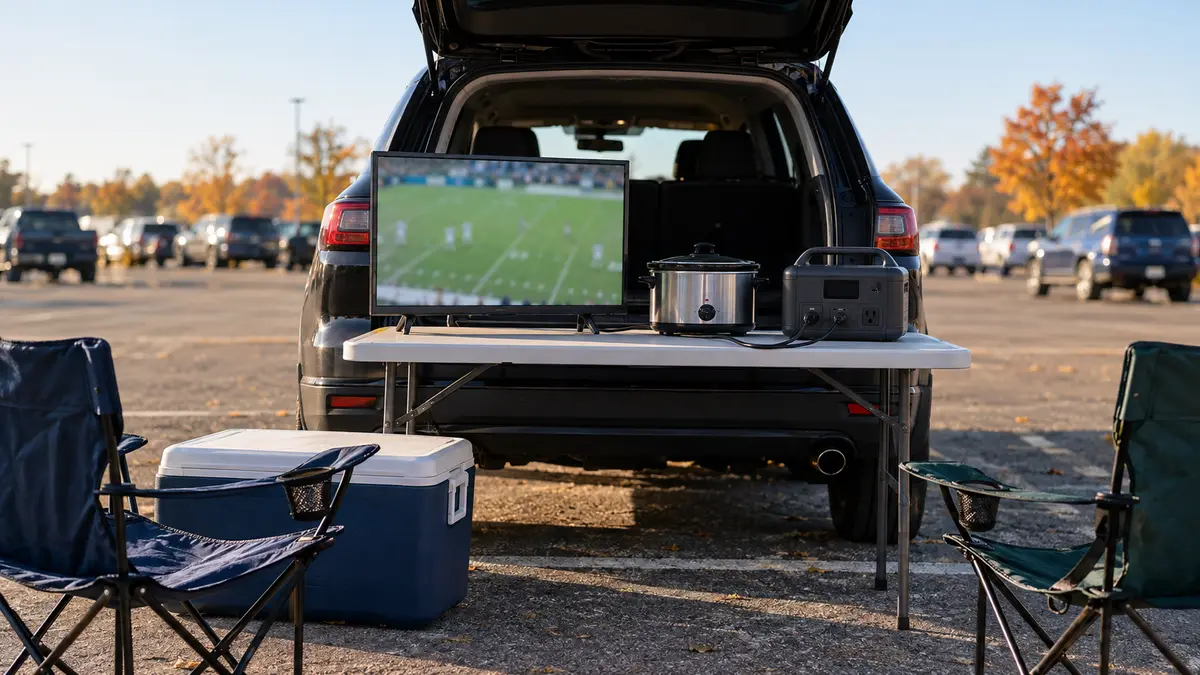
For music, phones and a 12V cooler, a small 300 Wh station lasts a whole 5-hour tailgate. Add a 43-inch TV and satellite internet and you need about 1,300 Wh; a 1,000 Wh class station covers about 4 hours of that. Add a slow cooker and plan on 1,700 Wh if it’s on warm, or about 2,700 Wh if it’s on high. Check your stadium’s rules first: some lots cap or ban generators.
A tailgate is a short, predictable job for a power station: a few hours, a known list of devices, and a drive home to a wall outlet. That makes it easy to size. Here are the numbers.
What tailgate gear draws
| Device (example model) | Watts | Source |
|---|---|---|
| 43-inch TV (Samsung DU8000, 2024) | 135 W maximum | Samsung spec page |
| Slow cooker, 7-quart (Crock-Pot programmable) | 70 W on low or warm, up to 250 W on high | Crock-Pot |
| Satellite internet (Starlink Mini) | 25–40 W average | Starlink spec sheet |
| 12V cooler/fridge (Dometic CFX3 45) | 12.4 W average on a 90°F day | Dometic |
| Bluetooth speaker | 20 W (example value) | Check your speaker’s label |
| Phone charging | 20 W per phone (example adapter) | Check your charger |
Specs checked on October 13, 2026. The TV figure is its maximum; at normal brightness it draws less, so our TV numbers are an upper estimate. Your own gear will differ: the watts are on each device’s label or power adapter.
Energy for a 5-hour tailgate
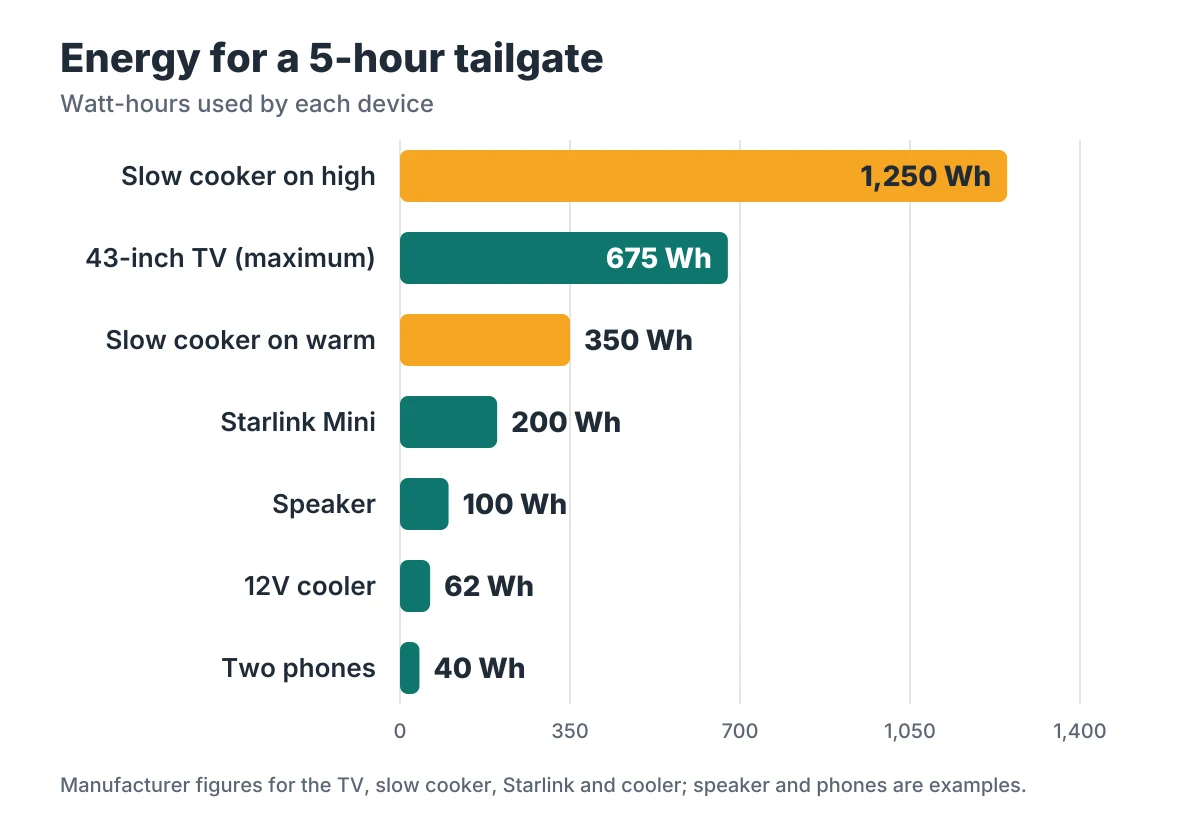
Energy is watts × hours. Over 5 hours (phones: two phones for 1 hour):
| Setup | Devices | Energy used | Battery needed (÷ 0.85) |
|---|---|---|---|
| Basic | Speaker, two phones, 12V cooler | 202 Wh | About 240 Wh |
| Game on TV | Basic + 43-inch TV + Starlink Mini | 1,077 Wh | About 1,270 Wh |
| TV + food kept warm | Game on TV + slow cooker on warm | 1,427 Wh | About 1,680 Wh |
| TV + cooking | Game on TV + slow cooker on high | 2,327 Wh | About 2,740 Wh |
The 0.85 is our planning assumption for inverter losses; we apply it to everything to keep the math simple, which is slightly pessimistic for the 12V cooler.
The slow cooker is the surprise. It draws few watts, but it runs the whole time: on high it uses almost twice the energy of the TV. Cook at home, bring the food hot, and use the cooker on warm.
How long three stations last
| Setup | Average load | EcoFlow RIVER 3 Plus (286 Wh) | Anker SOLIX C1000 (1,056 Wh) | EcoFlow DELTA 3 Max Plus (2,048 Wh) |
|---|---|---|---|---|
| Basic | 40 W | About 6 hours | About 22 hours | About 43 hours |
| Game on TV | 215 W | About 1.1 hours | About 4.2 hours | About 8.1 hours |
| TV + food kept warm | 285 W | About 0.9 hours | About 3.1 hours | About 6.1 hours |
| TV + cooking | 465 W | About 0.5 hours | About 1.9 hours | About 3.7 hours |
These are examples of three sizes, not recommendations. All three have enough output for these loads: even the smallest is rated for 600 W. Output only becomes the limit with heating appliances.
The gear that changes everything: electric grills, griddles and kettles
Appliances that heat fast are a different class of load: the examples in our guide to space heaters, microwaves and coffee makers draw about 1,500 W each. That needs a station rated above the appliance’s watts, and it drains a battery quickly: an hour at 1,500 W takes about 1,765 Wh. Check the label of any grill, griddle or kettle before you count on it. For a tailgate, cook with propane or charcoal as your lot allows, and keep the battery for the TV and the music.
Check your stadium’s rules
Every venue sets its own, and they differ a lot. A few examples from official pages:
- Los Angeles Chargers and Rams (SoFi Stadium): portable generators are capped at 600 watts.
- Arizona Cardinals: generators up to 6,500 watts are allowed.
- Houston Texans: generators that create excessive noise or harmful fumes are prohibited.
- Old Dominion University: gas generators are prohibited.
Most of these rules are written for fuel generators, and a battery station makes neither exhaust nor engine noise. Whether a wattage cap applies to a battery station depends on the venue, so read your stadium’s tailgating page or ask before game day.
Practical tips
- Charge it the night before. The stations we’ve checked refill from a wall outlet in about an hour; see How to Charge a Portable Power Station.
- Run the cooler from the 12V car port if it’s a 12V model. It skips the inverter and its losses.
- Keep the station in the shade and off wet ground, and check the operating temperature range in its manual.
- Bring it home with charge to spare in cold weather. The stations we’ve checked charge only above 32°F, so let a cold station warm up before plugging it in.
- Weight matters in a parking lot. A 1,056 Wh station like the SOLIX C1000 weighs 28.44 lb; the 286 Wh RIVER 3 Plus weighs 10.4 lb.
Safety: If anyone in your group brings a fuel generator, the U.S. Consumer Product Safety Commission warns never to run one in an enclosed or partly enclosed space. Its guidance for homes is outdoors only, at least 20 feet from the building, with the exhaust pointed away; at a tailgate, keep it well away from people, tents, canopies and open vehicles. Carbon monoxide can kill in minutes. Never use a charcoal or gas grill inside a vehicle, tent or enclosed canopy. For the power station, don’t overload its outlets, keep its vents clear and keep cords where nobody will trip on them.
Quick picks by tailgate
| Your tailgate | Starting point |
|---|---|
| Music, phones, a 12V cooler | About 300 Wh |
| A TV and streaming for the pregame | 1,000–1,300 Wh |
| TV plus a slow cooker on warm | About 1,700 Wh |
| TV plus cooking with electric appliances | 2,000 Wh or more, and check the rated output |
To size for your own gear, use the runtime calculator or follow the steps in What Size Portable Power Station Do I Need? To see where our numbers come from, read How We Research.