Watts vs Watt-Hours: How to Read a Power Station Spec Sheet
Watts (W) measure power: how much a device needs at one moment, and how much a power station can deliver at once. Watt-hours (Wh) measure energy: how much the battery holds. Watts tell you what you can run; watt-hours tell you for how long. A 1,056 Wh station with an 1,800 W output can run a 100 W load for about 9 hours, or an 1,800 W load for about half an hour.
The two questions every spec sheet answers
Think of a water tank with a tap. Watt-hours are the size of the tank; watts are how far the tap opens. A big tank with a small tap lasts a long time but can’t fill a bucket quickly. A small tank with a big tap can, but it’s empty in minutes.
| Your question | The number to look at |
|---|---|
| Can it run my device at all? | Rated (continuous) output, in watts |
| Can it start a fridge or a pump? | Surge (peak) output, in watts |
| How long will it run? | Capacity, in watt-hours |
| How fast does it recharge? | Input, in watts |
The link between the two is time:
energy (Wh) = power (W) × time (h)
runtime (h) = battery Wh × 0.85 ÷ load W
The 0.85 is our planning assumption for inverter losses on the AC outlets. Our runtime calculator applies it for a whole list of devices.
Same battery, different loads
The same 1,056 Wh battery lasts very different times depending on what you plug in:
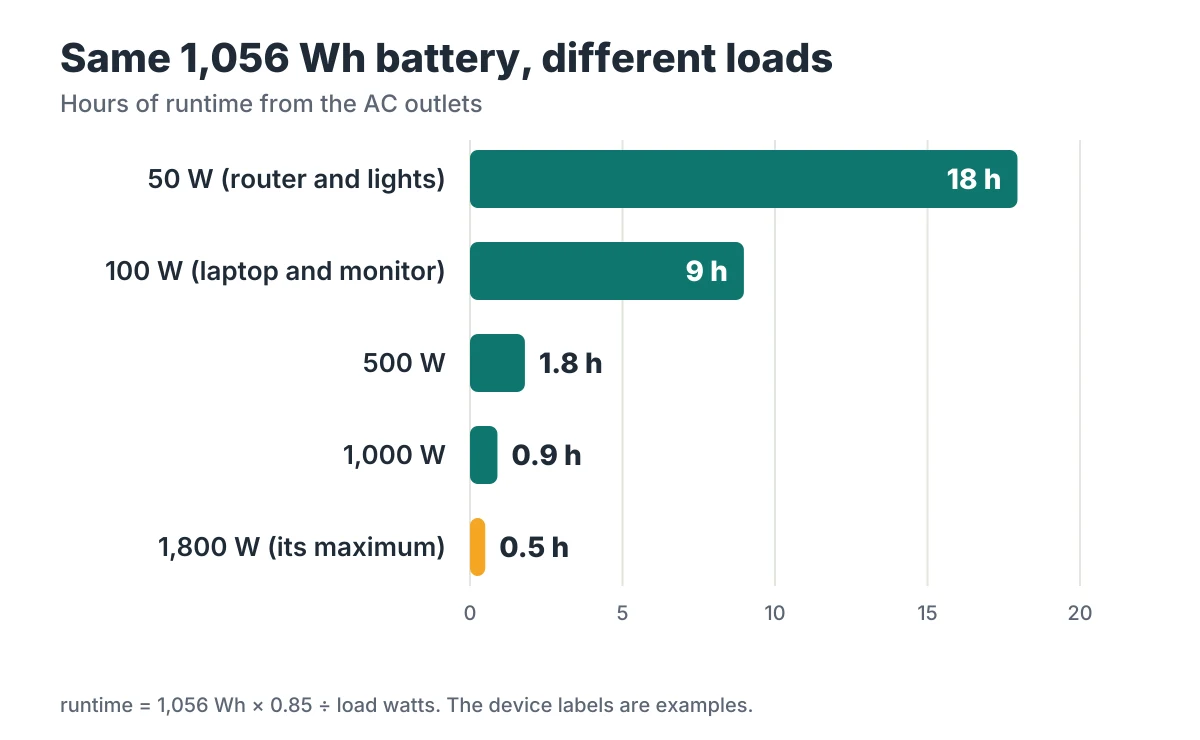
That’s why “how long does a 1,000 Wh power station last?” has no single answer. It depends on the watts of the load. For the heavy end of that chart, see Can a Power Station Run a Space Heater or a Microwave?
A real spec sheet, line by line
Here are the main lines from Anker’s spec sheet for the SOLIX C1000, and what each one means in practice:
| Spec line | What it tells you |
|---|---|
| Capacity: 1,056 Wh | The size of the tank. About 898 Wh reaches your AC devices after inverter losses (1,056 × 0.85). |
| AC continuous output: 1,800 W | The most it can deliver steadily. The total of everything running at once has to stay under this. |
| AC surge output: 2,400 W | A short burst for starting motors. It isn’t a level you can run at. |
| USB-C output: 100 W | The limit of that single port. A laptop that wants more will charge slower. |
| Cigarette lighter output: 120 W, 12 V/10 A | Watts are volts × amps: 12 × 10 = 120. This is the limit for a 12V fridge or other 12V devices. |
| AC input recharge: 1,300 W max | How fast it refills from a wall outlet: 1,056 ÷ 1,300 = 0.8 hours at best. |
| Solar input recharge: 600 W max, 11–60 V | The most solar power it accepts, and the voltage your panels must stay within. |
| Battery life cycles: 3,000 (80% capacity) | After 3,000 full charge cycles, the tank is rated to still hold 80%: about 845 Wh. |
Specs checked on October 6, 2026 from the manufacturer’s page. For the charging lines, see How to Charge a Portable Power Station. For cycle life, see LiFePO4 vs NMC Power Stations.
Three mistakes these numbers prevent
- Buying by the big watt number. A “2,000 W” station is not bigger than a “1,000 Wh” one; they’re different measurements. Compare watts with watts and watt-hours with watt-hours. Our comparison of 1,000 Wh class stations lines up both numbers for four models.
- Planning to run at the surge rating. The surge figure is for a brief startup. Size your devices’ total against the continuous output.
- Dividing capacity by watts and stopping there. Losses take a share. That’s what the 0.85 is for.
Amp-hours, milliamp-hours and kilowatt-hours
Amp-hours (Ah) measure charge, not energy. To compare batteries you need watt-hours:
Wh = Ah × volts
A 12 V battery rated at 8 Ah holds 12 × 8 = 96 Wh.
A 100 Ah battery at 12.8 V holds 100 × 12.8 = 1,280 Wh.
The same amp-hours mean different energy at different voltages, so an Ah or mAh figure alone doesn’t tell you the capacity. If a listing gives only mAh, look for the Wh figure or the voltage before comparing it with anything.
Kilowatt-hours (kWh) are thousands of watt-hours: 1,056 Wh = 1.056 kWh. It’s the unit on your electricity bill, which makes costs easy to estimate. At the U.S. average residential price of 18.31 cents per kWh (July 2026, U.S. Energy Information Administration), filling that battery from the wall costs about 21 cents, assuming 90% charging efficiency.
Where watt-hours matter away from home: flying
Airline battery limits are written in watt-hours. The FAA allows lithium-ion batteries up to 100 Wh for passengers; batteries from 101 to 160 Wh need the airline’s approval, and larger ones are forbidden. Portable power stations are generally far above that: even the small EcoFlow RIVER 3 Plus, at 286 Wh, is over the limit. Check the FAA’s PackSafe page and your airline’s rules before you travel; airlines can be stricter.
What to do with these numbers
- List your devices and their watts (it’s on each device’s label or power adapter).
- Check that the total, plus any startup surge, fits the station’s watts.
- Multiply each device’s watts by its hours of use to get watt-hours per day.
- Compare that with the station’s capacity, allowing for losses.
What Size Portable Power Station Do I Need? walks through those steps with examples. To see where our numbers come from, read How We Research.