Portable Power Station for Home Backup: What It Can Run
A portable power station can keep your essentials running through a typical outage: the refrigerator, Wi-Fi, phones, a few lights and a CPAP. It can’t run a whole house, central air, an electric water heater or anything wired into your electrical panel. For 12 hours of essentials, plan for about 1,000–1,500 Wh; for 24 hours, about 2,000 Wh. Plug devices directly into the station, and keep it charged before storm season.
How long do outages last?
According to the U.S. Energy Information Administration, U.S. electricity customers averaged 11 hours without power in 2024, nearly twice the average of the previous decade. Major events such as hurricanes caused 80% of those hours; outages from everyday causes average about two hours a year. The spread between states is huge: customers in South Carolina averaged nearly 53 hours in 2024, while those in Arizona, the Dakotas and Massachusetts averaged under two.
So a station that covers a day of essentials handles most outages. For the long ones after major storms, you’ll need a way to recharge it or a backup plan.
What a power station can and can’t run
| Good fit | Possible, check watts and runtime | Not a fit |
|---|---|---|
| Refrigerator or freezer | Microwave, coffee maker, kettle (short use, high watts) | Central air conditioning |
| Wi-Fi router and modem | Window AC unit (large stations only, short runtime) | Electric water heater |
| Phones, laptops, tablets | Space heater (drains a battery fast) | Electric range or oven |
| LED lights and lamps | Sump pump (check starting watts) | Anything hardwired into your panel |
| CPAP machine | TV | Whole-house backup |
For the high-watt appliances in the middle column, Can a Power Station Run a Space Heater or a Microwave? has the watts and the battery each one uses. Two numbers decide what works. The rated output in watts has to cover everything running at once, plus the startup surge of fridges and pumps. The capacity in watt-hours decides how long it lasts. Our sizing guide explains both, and the runtime calculator does the math for your devices.
How big a station for 12 or 24 hours?
A typical essentials list, using a median ENERGY STAR top-freezer refrigerator from our refrigerator guide:
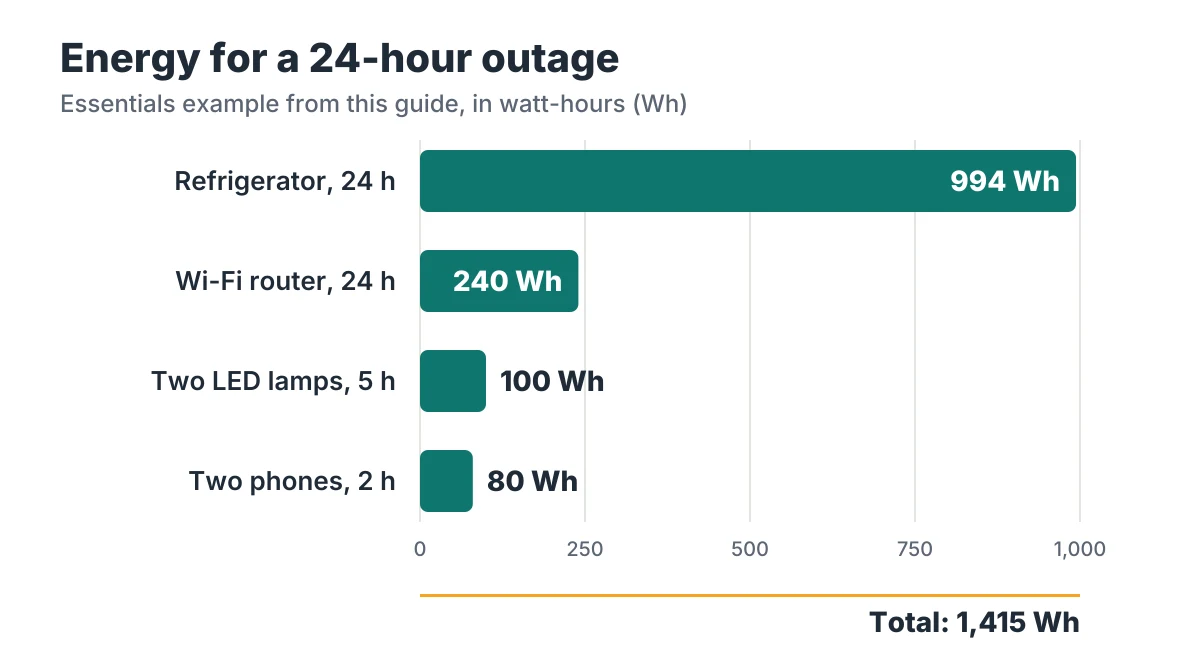
| Device | Watts | 12-hour outage | 24-hour outage |
|---|---|---|---|
| Top-freezer refrigerator (average, 363 kWh/year) | 41.4 | 497 Wh | 994 Wh |
| Wi-Fi router (example label value) | 10 | 120 Wh | 240 Wh |
| Two phones charging, 2 h (example: 20 W adapters) | 40 | 80 Wh | 80 Wh |
| Two LED lamps, 5 h (example: 10 W each) | 20 | 100 Wh | 100 Wh |
| Total | 797 Wh | 1,415 Wh |
12 hours: 797 Wh ÷ 0.85 = 938 Wh, plus 20% = about 1,130 Wh
24 hours: 1,415 Wh ÷ 0.85 = 1,665 Wh, plus 20% = about 2,000 Wh
The 0.85 covers inverter losses and the 20% margin is our rule of thumb for battery aging and surprises; neither is a measured value. For four current models in that 2,000 Wh class, see 2000 Watt Power Stations Compared; for two days or more, 3000 Watt Solar Generators Compared. If someone in the house uses a CPAP with a heated humidifier, add roughly 176 Wh per night based on ResMed’s measurements; see our CPAP guide. A bottom-freezer or side-by-side fridge uses more than the top-freezer in this example.
Features that matter for home backup
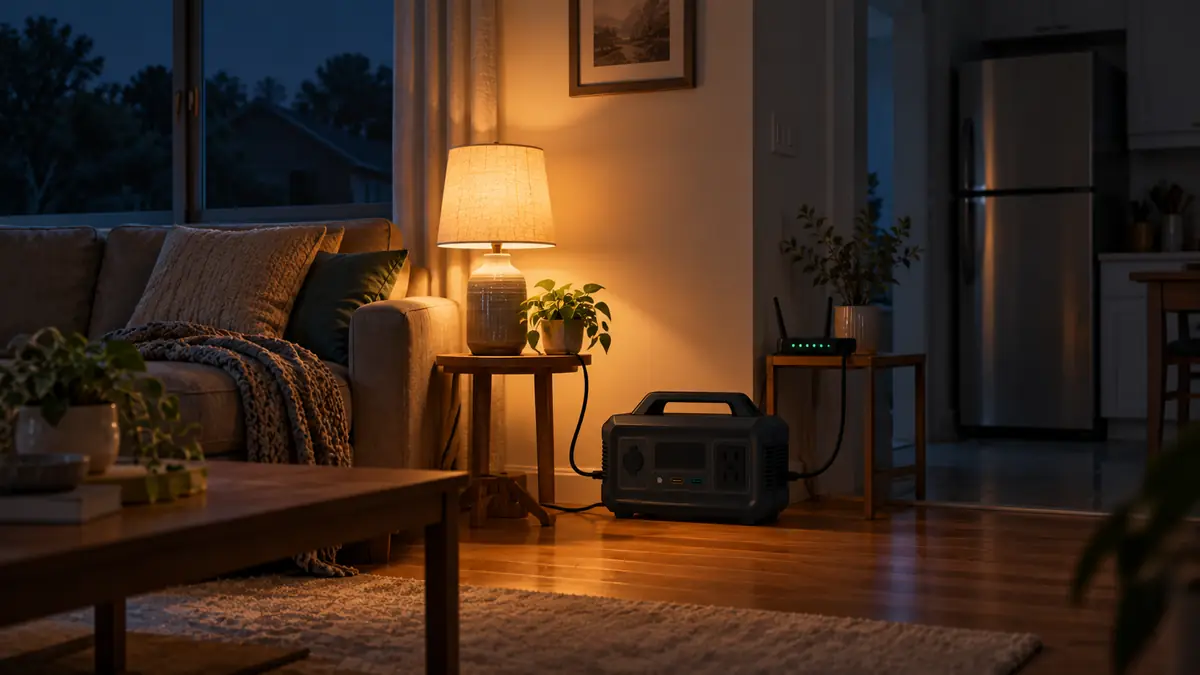
- Automatic switchover (UPS): some stations pass wall power through to your devices and switch to battery by themselves when the grid fails. The RIVER 3 Plus and DELTA 3 Max Plus list under 10 ms; the SOLIX C1000 lists under 20 ms. Leave the fridge or router plugged in through the station and it keeps running even if the power goes out at night.
- Enough output for the fridge’s startup surge. Check the fridge’s starting watts against the station’s surge rating, and test it before you need it.
- A way to recharge in long outages. Solar panels are the usual option; our Solar Panel Size Calculator estimates how many watts you need in your state and month. In an apartment, a balcony gets much less sun than those figures; see Solar Generator for an Apartment. If you’re weighing a fuel generator instead, see our battery vs gas generator comparison.
- LiFePO4 cells if you’ll keep the station in the house for years; they’re rated for far more cycles than older NMC models.
Before the next outage
- Charge it fully and check the manual for how often to top it up in storage.
- Test your setup: run the fridge from the station for an hour and watch the compressor start.
- Write down what you’ll plug in, in order of priority, so you’re not deciding in the dark.
- Know the food-safety limits. A closed refrigerator keeps food safe for up to 4 hours without power, according to the USDA; our refrigerator guide covers the details.
Safety: Plug devices directly into the station. Don’t connect a portable power station to your home’s electrical panel or wiring yourself; that requires a transfer switch or inlet installed by a licensed electrician. If you also use a fuel generator, run it outdoors only, at least 20 feet from the house, with the exhaust pointed away: carbon monoxide can kill in minutes.
To see where our numbers come from, read How We Research.