3000 Watt Solar Generators Compared: 4 Home Backup Models
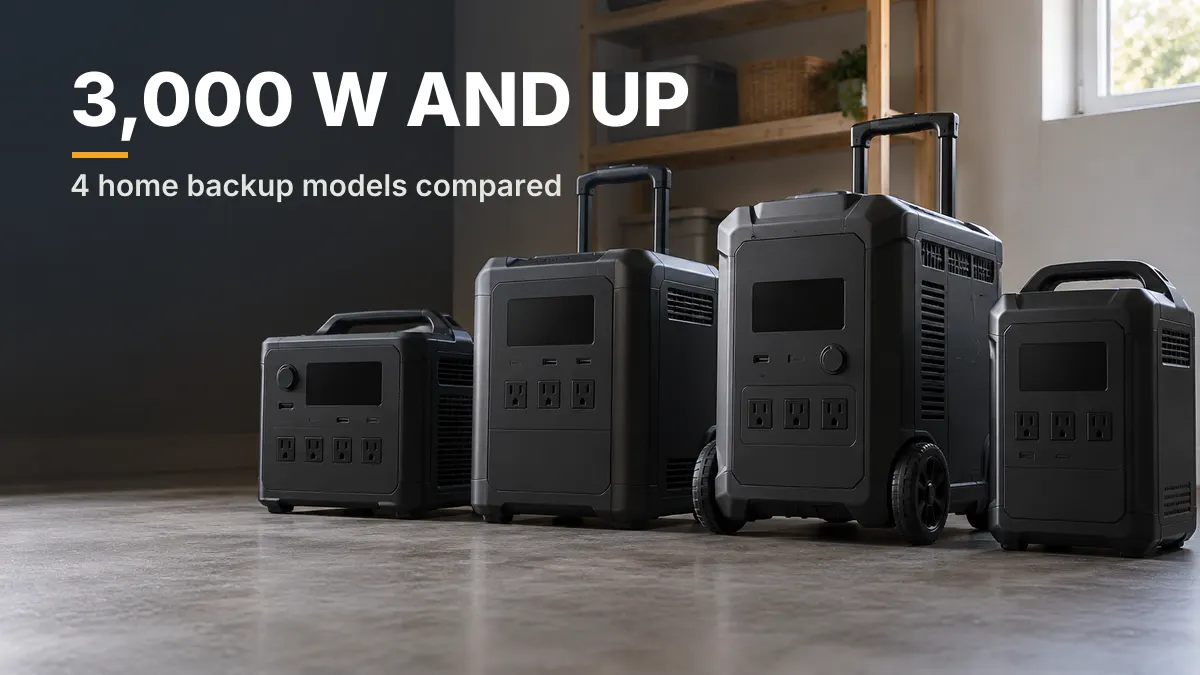
Four 3,000 W and up stations compared on their official specs: the EcoFlow DELTA Pro 3, Anker SOLIX F3800 Plus, Jackery HomePower 3000 and BLUETTI Apex 300. This is home backup territory: 2,765 to 4,096 Wh, enough for about 1.7 to 2.5 days of outage essentials, and three of the four also deliver 240 V. The differences that matter: the Anker has the most output (6,000 W) and solar input but weighs 136.7 lb; the Jackery is by far the lightest (59.5 lb) but is 120 V only; the EcoFlow holds the most energy; the BLUETTI lists the most cycles and a 0 ms switchover.
How we compared: we don’t physically test products and no brand paid for a place on this page. Every figure comes from the manufacturer’s official U.S. product page, checked on October 21, 2026. There are no affiliate links on this page. See How We Research.
The specs side by side
| EcoFlow DELTA Pro 3 | Anker SOLIX F3800 Plus | Jackery HomePower 3000 | BLUETTI Apex 300 | |
|---|---|---|---|---|
| Capacity | 4,096 Wh | 3,840 Wh | 3,072 Wh | 2,764.8 Wh |
| Rated AC output | 4,000 W | 6,000 W | 3,600 W | 3,840 W |
| Surge | 8,000 W | Not listed | 7,200 W | Not listed (7,680 W “lifting power”) |
| 240 V output | Yes (L14-30 and 6-20 outlets) | Yes (L14-30 outlet) | No, 120 V only | Yes (14-50 outlet) |
| 30-amp RV outlet | TT-30R | TT-30, 3,000 W max (per Anker’s comparison table) | 30 A, 120 V outlet (3,600 W) | TT-30R |
| Weight | 113.5 lb | 136.7 lb (with wheels) | 59.5 lb | 83.8 lb |
| AC charging (manufacturer figures) | 100–240 V, 15 A; 80% in 50 min | 1,800 W max at 120 V; up to 6,000 W via 240 V adapter port | 120 V, 15 A; 2.2 h | 120 V, 15 A; “turbo” up to 3,840 W, 80% in 45 min |
| Max solar input | 2,600 W (two ports, up to 150 V) | 3,200 W (2 × 1,600 W, 11–165 V) | 1,000 W (12–60 V) | 2,400 W (2 × 1,200 W, 12–60 V) |
| UPS switchover | 10 ms | Not listed | About 20 ms | 0 ms |
| Rated cycle life | 4,000 to 80% | 3,000+ (no capacity % listed) | 4,000 to 70%+ | 6,000+ to 80% |
| Expansion | Up to 12 kWh per unit | Up to 6 batteries, 53.8 kWh | Not listed | Up to 6 battery packs |
| USB ports | Built in | Built in | Built in | Need the Hub D1 accessory |
| Charging temperature | 32–113°F | Not listed | 32–113°F | 32–104°F |
| Warranty | 5 years | 5 years | 3 + 2 years | 5 years |
Specs checked on October 21, 2026 from each manufacturer’s U.S. product page. Charging times and cycle ratings are each manufacturer’s own figures. BLUETTI lists 7,680 W as “lifting power”, not as a surge rating. We don’t list prices: they change often.
What the differences mean
Capacity: days, not hours
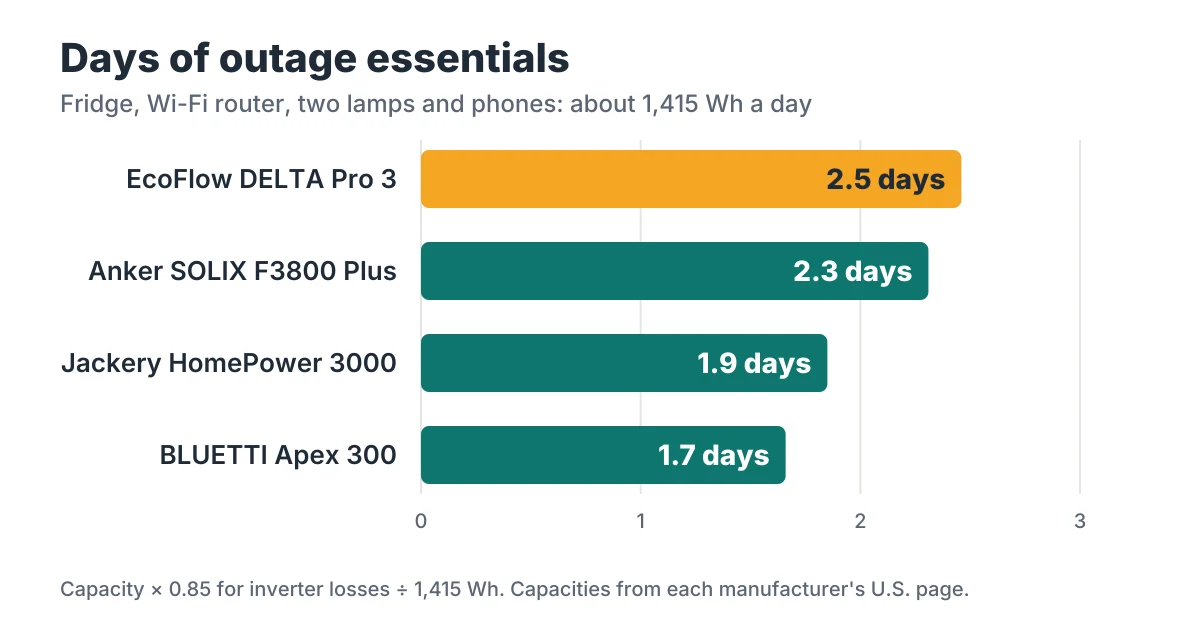
Our home backup guide puts a day of essentials (fridge, Wi-Fi router, two lamps, phones) at about 1,415 Wh. With our 0.85 allowance for inverter losses, the DELTA Pro 3 covers about 2.5 days of that list, the F3800 Plus 2.3, the HomePower 3000 1.9 and the Apex 300 1.7. Three of the four accept expansion batteries if you need more.
240 V: useful, but not a do-it-yourself connection
Three of the four have 240 V outlets, which some heavy appliances and well pumps need. Using them to power house circuits is a different matter: that requires a transfer switch or power inlet installed by a licensed electrician, never a cord plugged into the panel. If you only plan to plug appliances directly into the station, 240 V matters only for appliances with 240 V plugs. The Jackery is 120 V only; its page notes that feeding house circuits requires a manual transfer switch.
Weight: all of them roll, one of them you can lift
At 59.5 lb, the Jackery stores about 52 Wh per pound; the Anker, at 136.7 lb including wheels, about 28. That’s a 77 lb difference. These stations mostly sit in a garage or utility room, so weight matters less than in the smaller classes, but stairs and car trunks still count.
Charging: the 120 V outlet is the bottleneck
A standard 15-amp circuit supplies 1,800 W, and all four list 15 A (or 1,800 W) as their limit from a 120 V outlet. At that rate, filling 3,000–4,000 Wh takes about 2 hours or more. Some of the fast times on the spec sheets can’t come from a 120 V outlet: EcoFlow’s 80% in 50 minutes works out to about 3,900 W (4,096 × 0.8 ÷ 50 min), and BLUETTI’s 80% in 45 minutes to about 2,900 W. They need a 240 V source or a combination of inputs; check the manual for what your setup allows. Our charging guide explains the circuit math.
Solar: built for real arrays
From 1,000 W on the Jackery to 3,200 W on the Anker. The Anker accepts up to 165 V per input and the EcoFlow up to 150 V on its high-voltage port, which allows long strings of panels in series; the Jackery and the BLUETTI stop at 60 V. To refill 4,096 Wh in one day in Phoenix you’d need about 800 W of panels (4,096 ÷ (6.68 × 0.77)); our Solar Panel Size Calculator does that math for your state and month.
UPS and cycle life
The BLUETTI lists a 0 ms switchover, the EcoFlow 10 ms and the Jackery about 20 ms; we didn’t find a figure on the Anker page. Cycle ratings use different bars: the BLUETTI (6,000+) and the EcoFlow (4,000) are rated to 80% of capacity, the Jackery (4,000) to 70%, and the Anker page lists 3,000+ cycles without a percentage.
One detail to check: USB ports
The Apex 300’s USB-C and USB-A ports require BLUETTI’s Hub D1 accessory. If you want to charge phones and laptops straight from the station, budget for it or use the AC outlets with a charger.
Is this class the right one?
A station in this class is a home backup system on wheels. Before you compare models, check two things:
- Do you need this much? For a fridge, internet and lights through a one-day outage, about 2,000 Wh is enough: see 2000 Watt Power Stations Compared. Our sizing guide works it out from your own devices.
- Battery or fuel? For multi-day outages with no sun, a fuel generator (outdoors only) or a combination may make more sense. Battery Powered Generator vs Gas Generator compares the two.
Which one fits which use
Based only on the specs above:
| If you care most about… | Look at |
|---|---|
| Maximum output and solar, expandable to a whole-home system | Anker SOLIX F3800 Plus: 6,000 W, 3,200 W solar, but 136.7 lb |
| The most energy in a single unit | EcoFlow DELTA Pro 3: 4,096 Wh, 120/240 V |
| Something one person can lift into a car | Jackery HomePower 3000: 59.5 lb, 120 V only |
| Fastest switchover and longest rated cycle life | BLUETTI Apex 300: 0 ms, 6,000+ cycles to 80% |
Safety: Plug appliances directly into the station. Don’t connect a power station to your home’s electrical panel or wiring yourself, at 120 V or 240 V; that requires a transfer switch or inlet installed by a licensed electrician. If you also run a fuel generator, keep it outdoors only, at least 20 feet from the house: carbon monoxide can kill in minutes.