Solar Generator for an Apartment: What a Balcony Can Power
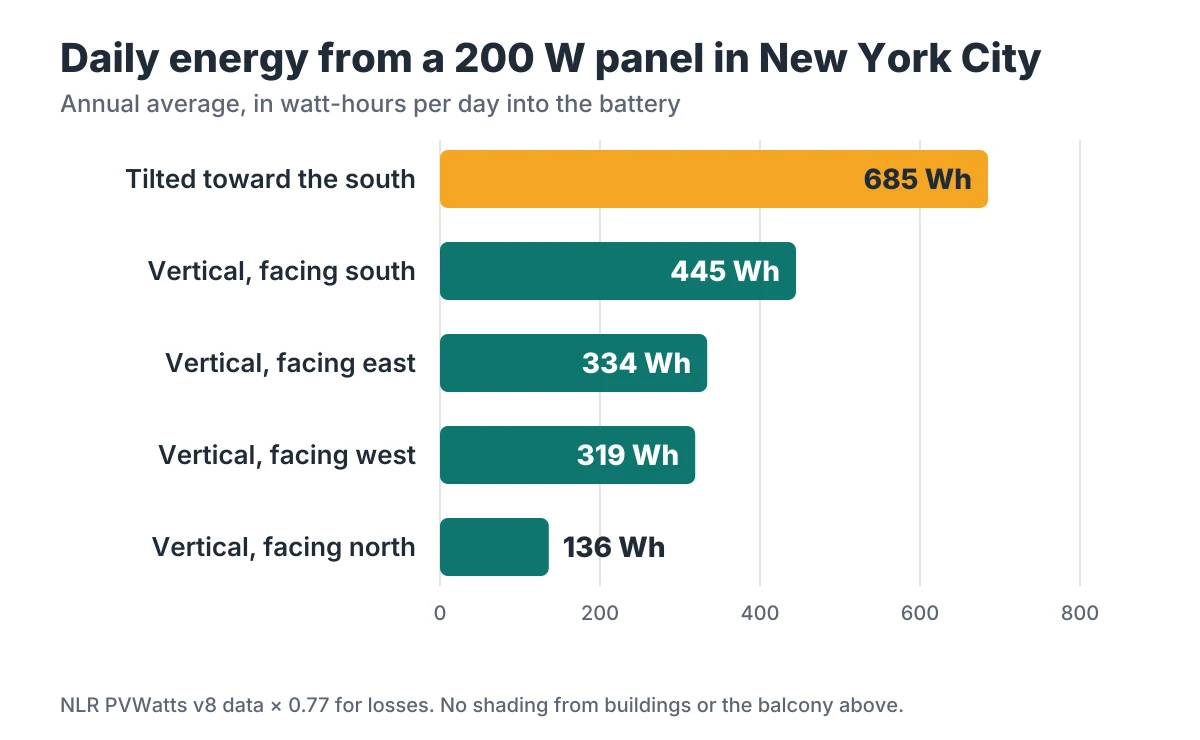
A solar generator (a portable power station plus a folding panel) works in an apartment because it burns no fuel and makes no exhaust, so it can sit indoors. The limit is the balcony. In New York City, a 200 W panel hung vertically on a south-facing railing averages about 445 Wh a day; facing east or west, about 320–335 Wh; facing north, about 135 Wh. That’s enough for a router, phones, lights and a laptop on a good balcony, not for a whole apartment. Its strongest use is quiet backup for outages, charged from the wall.
What “solar generator” means in an apartment
A solar generator is two things: a portable power station (a battery with outlets) and one or more portable solar panels that recharge it. You plug your devices into the station. Nothing connects to the building’s wiring.
That’s different from plug-in “balcony solar”, where a panel with a small inverter plugs into a wall outlet and feeds the apartment’s circuits. Those systems are regulated: Utah, for example, passed a law in 2025 (H.B. 340) covering portable solar devices of up to 1,200 watts that plug into a standard 120-volt outlet, and rules elsewhere vary. This guide is only about the first kind: panel to station, station to your devices.
A fuel generator is not an option in an apartment at all. The U.S. Consumer Product Safety Commission warns never to run one indoors or in any enclosed area, and to keep it at least 20 feet from the building. A balcony doesn’t meet that.
How much sun does a balcony get?
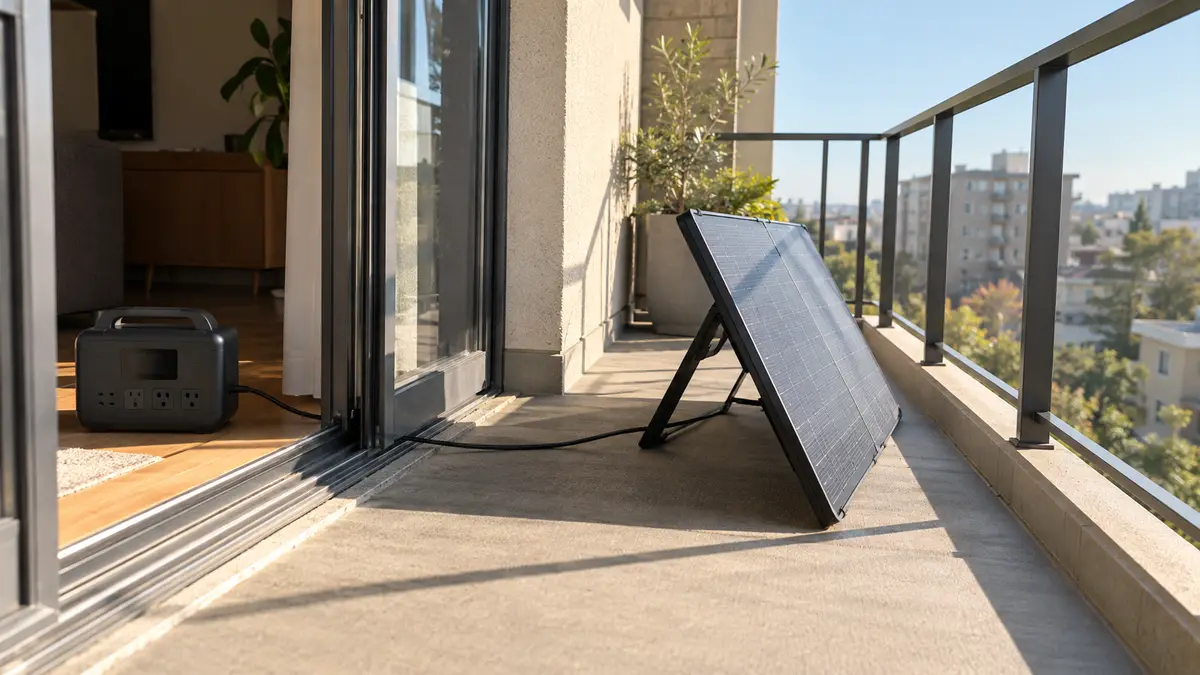
Less than a roof or a campsite, for two reasons. A balcony faces one direction, and a panel hung on the inside of a railing sits vertically instead of tilted toward the sun.
We ran those cases through PVWatts, the solar calculator of the National Laboratory of the Rockies (NLR, formerly NREL). The numbers are annual average peak sun hours per day on the panel:
| City | Tilted toward the south (best case) | Vertical, facing south | Vertical, facing east | Vertical, facing west | Vertical, facing north |
|---|---|---|---|---|---|
| New York City | 4.45 | 2.89 | 2.17 | 2.07 | 0.88 |
| Chicago | 4.46 | 2.93 | 2.15 | 2.18 | 0.91 |
| Los Angeles | 6.09 | 3.62 | 2.67 | 3.00 | 1.01 |
| Seattle | 3.82 | 2.59 | 1.81 | 1.97 | 0.79 |
| Miami | 5.57 | 2.91 | 2.71 | 2.49 | 1.09 |
| Denver | 5.73 | 3.90 | 2.91 | 2.64 | 1.10 |
Three things stand out:
- A vertical south-facing panel gets about 50–70% of the best case, depending on the city.
- East and west get about half.
- North gets about a fifth. A north-facing balcony isn’t worth a panel.
These figures assume nothing shades the panel. In a real building, the balcony above, the walls beside you and the buildings across the street can each take a large share, and we can’t put a number on that for your balcony. Watch where direct sun actually lands, and for how many hours, before you buy panels.
One more surprise from the data: a vertical south-facing panel does comparatively well in winter, when the sun is low. In New York City it gets 3.52 peak sun hours a day in January, almost the same as a tilted panel (3.57), but only 2.06 in June.
If your balcony floor gets direct sun, standing the panel on its kickstand and angling it toward the sun beats hanging it flat against the railing.
What that means in watt-hours
Wh per day into the battery = panel watts × peak sun hours × 0.77
200 W, vertical, facing south, New York City: 200 × 2.89 × 0.77 = about 445 Wh a day
Same panel facing east: 200 × 2.17 × 0.77 = about 334 Wh a day
The 0.77 is the planning factor from our Solar Panel Size Calculator for real-world losses, including charging the battery.
What can that power?
A light everyday list for an apartment:
| Device | Watts | Hours/day | Wh/day |
|---|---|---|---|
| Wi-Fi router (example label value) | 10 | 24 | 240 |
| Laptop (example: 60 W adapter) | 60 | 3 | 180 |
| Two LED lamps (example: 10 W each) | 20 | 5 | 100 |
| Two phones charging (example: 20 W adapters) | 40 | 2 | 80 |
| Total | 600 |
Delivering 600 Wh from the AC outlets takes about 706 Wh from the battery (600 ÷ 0.85). In New York City:
- South-facing, vertical: you’d need about 320 W of panels to keep up (706 ÷ (2.89 × 0.77)). With 200 W you cover roughly 60%.
- East-facing, vertical: about 420 W.
- Panel tilted toward the south in full sun: about 205 W.
So a sunny balcony with one or two folding panels can run your desk and your internet. It won’t run the apartment: a refrigerator alone averages about 994 Wh a day (the ENERGY STAR top-freezer average from our refrigerator guide), and air conditioning or electric heat are far beyond it.
The better reason to own one in an apartment: outages
Solar on a balcony is slow. A wall outlet is not: the stations we’ve checked recharge in about an hour (see How to Charge a Portable Power Station). For most apartment dwellers the practical plan is:
- Keep the station charged from the wall.
- Use it during outages for the fridge, router, phones and lights. Our home backup guide sizes that: about 1,000–1,500 Wh for 12 hours of essentials, about 2,000 Wh for 24.
- Treat the balcony panel as a way to stretch a long outage, adding a few hundred watt-hours a day, and as a way to run small loads off-grid the rest of the time.
Sizing for a balcony
- Panels: start from the space and the sun you really have. A single 100–200 W folding panel is a realistic starting point for a small balcony. Check that its voltage and connector match the station’s solar input.
- Station: size it for the outage you want to cover, not for the panel. Our sizing guide has the steps.
- Weight: you’ll carry it up the stairs when the elevator is out. A 1,056 Wh station like the Anker SOLIX C1000 weighs 28.44 lb.
Rules and safety on a balcony
- Check your lease or building rules before putting panels on a balcony or attaching anything to a railing. Some buildings restrict what can be mounted or visible.
- Keep panels inside the railing and secured. A folding panel is a sail in the wind. Nothing should hang where it could fall on someone below.
- Don’t run a cable through a door or window in a way that pinches it. Check the cable and the manual of your panel.
- Behind glass doesn’t count. A panel indoors behind a window gets less light than one outside; we don’t have a sourced figure for how much, so don’t plan around it.
Safety: Plug devices directly into the station. Don’t connect a power station or solar panels to your apartment’s outlets or wiring to feed the building; that requires equipment and approvals that depend on local rules, and a licensed electrician. Keep the station within the temperatures in its manual (the ones we’ve checked charge only above 32°F), out of rain, and with its vents clear. Never run a fuel generator indoors or on a balcony, and never use a grill or camp stove indoors: carbon monoxide can kill in minutes.
To see where our numbers come from, read How We Research.