
Can a Portable Power Station Run a Refrigerator?
Yes, if the station’s rated output covers the fridge’s running watts and its startup surge. How long it lasts depends on the fridge: based on ENERGY STAR data, a typical top-freezer fridge averages about 41 W, so a 1,056 Wh station runs it for roughly 22 hours. A typical side-by-side averages about 73 W, closer to 12 hours on the same station.
A refrigerator is one of the most common reasons people buy a portable power station, usually for power outages. The good news is that fridges use less energy than most people expect, because the compressor cycles on and off. The catch is the moment it starts: that surge decides whether a station can run it at all.
How much power does a refrigerator really use?
There are two numbers to keep apart:
- Running watts: what the compressor draws while it’s on. The label on the fridge or in its manual shows the maximum.
- Average watts: what it uses over a whole day, including the time the compressor is off. That’s the number that decides runtime.
The U.S. Department of Energy notes that fridges cycle on and off to hold their temperature, and suggests assuming a fridge runs at its maximum wattage about one third of the time. A more precise source is the yellow EnergyGuide label on U.S. fridges, which lists estimated yearly energy use in kWh:
average W = kWh per year × 1,000 ÷ 8,760 hours
Typical consumption by type of fridge
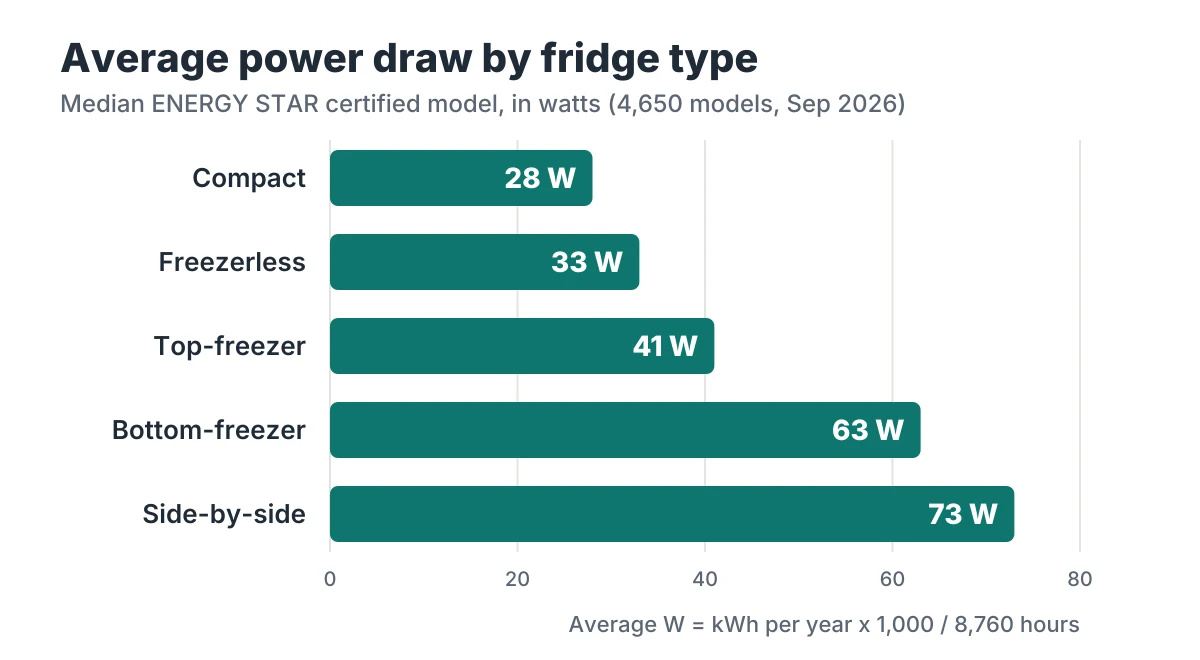
We downloaded the ENERGY STAR list of certified refrigerators and freezers (4,830 models, September 26, 2026) and grouped the five main refrigerator types (4,650 models). The median is the middle model of each group; the typical range covers the middle half of models.
| Type | Models | Median kWh/year | Typical range | Average watts (median) | Wh per day |
|---|---|---|---|---|---|
| Compact refrigerator | 1,741 | 246 | 218–278 | 28 W | 674 |
| Freezerless / single door | 294 | 288 | 254–314 | 33 W | 789 |
| Top-freezer | 832 | 363 | 332–390 | 41 W | 995 |
| Bottom-freezer | 1,660 | 556 | 465–634 | 63 W | 1,523 |
| Side-by-side | 123 | 640 | 594–694 | 73 W | 1,753 |
These are certified, energy-efficient models, measured with a standard test. An older fridge, a hot kitchen, frequent door openings or an ice maker will push real use higher. If you have your fridge’s EnergyGuide label, use its number instead.
How long a power station runs a fridge
Runtime with the median fridge of each type, using 0.85 for inverter losses (our standard planning assumption) and no other loads:
| Type (average W) | 1,056 Wh station | 2,048 Wh station | 3,000 Wh station |
|---|---|---|---|
| Compact (28 W) | 32 h | 62 h | 91 h |
| Freezerless (33 W) | 27 h | 53 h | 78 h |
| Top-freezer (41 W) | 22 h | 42 h | 62 h |
| Bottom-freezer (63 W) | 14 h | 27 h | 40 h |
| Side-by-side (73 W) | 12 h | 24 h | 35 h |
The 1,056 Wh and 2,048 Wh columns match the capacities of the Anker SOLIX C1000 and the EcoFlow DELTA 3 Max Plus; 3,000 Wh is a round reference. Treat these as best cases and plan with a margin. To run the numbers for your own fridge and other devices, use our runtime calculator, which converts the EnergyGuide kWh figure for you.
Example: top-freezer, 363 kWh/year → 363 × 1,000 ÷ 8,760 = 41.4 W. On 1,056 Wh: 1,056 × 0.85 ÷ 41.4 = 21.7 hours.
Startup surge: the part that decides if it works
When the compressor starts, it pulls much more power for a moment than while it runs. If that spike is above the station’s surge rating, the station cuts out and the fridge won’t start, no matter how much energy is stored.
Power station makers often quote startup surges several times the running watts, but we couldn’t find an independent measurement to cite, so we don’t give a multiplier here. What you can do:
- Check the fridge’s manual or the manufacturer’s support page for its starting or running amps. Watts = amps × 120 V.
- Compare with the station’s surge rating. For example: RIVER 3 Plus, 1,200 W surge (600 W rated); SOLIX C1000, 2,400 W surge (1,800 W rated); DELTA 3 Max Plus, 6,000 W surge (3,000 W rated). Specs checked on September 26, 2026 from the manufacturers’ pages.
- Test it before you need it. With the fridge plugged straight into the fully charged station, wait for the compressor to start a few times. If the station keeps running, you’re set.
Do you need to run it all day?
Not always. According to FoodSafety.gov, citing the USDA, a closed refrigerator keeps food safe for up to 4 hours without power. A full freezer holds a safe temperature for about 48 hours, or 24 hours if it’s half full and the door stays closed. The safe limit for refrigerated food is 40°F (4°C).
That opens two ways to stretch a small station during an outage:
- Keep the door closed as much as possible. Every opening makes the compressor work longer.
- Power the fridge in blocks instead of nonstop, as long as it stays at 40°F or below. Put an appliance thermometer inside so you know instead of guessing. When in doubt, follow the USDA guidance and throw out perishable food that has been above 40°F for more than 2 hours.
Features that help with a fridge
- Rated output and surge that cover the startup spike (see above).
- UPS or automatic switchover: the station passes wall power to the fridge and switches to battery by itself when the grid fails. The RIVER 3 Plus and DELTA 3 Max Plus list under 10 ms; the SOLIX C1000 lists under 20 ms. It means the fridge keeps running even if the outage starts at 3 a.m.
- Enough capacity for your outage length. Our sizing guide shows the full method, including a one-day outage example with a fridge, router and phones.
- For camping: a 12V compressor fridge uses much less than a household one. We cover that case in our camping guide.
Safety: Plug the fridge directly into the station. Don’t connect a portable power station to your home’s electrical panel or wiring yourself; that requires a transfer switch or inlet installed by a licensed electrician. If you use a fuel generator instead, never run it indoors, in a garage or near windows: carbon monoxide can kill in minutes.
To see where our numbers come from, read How We Research.