300 Watt Power Stations Compared: 4 Small Models, Real Specs
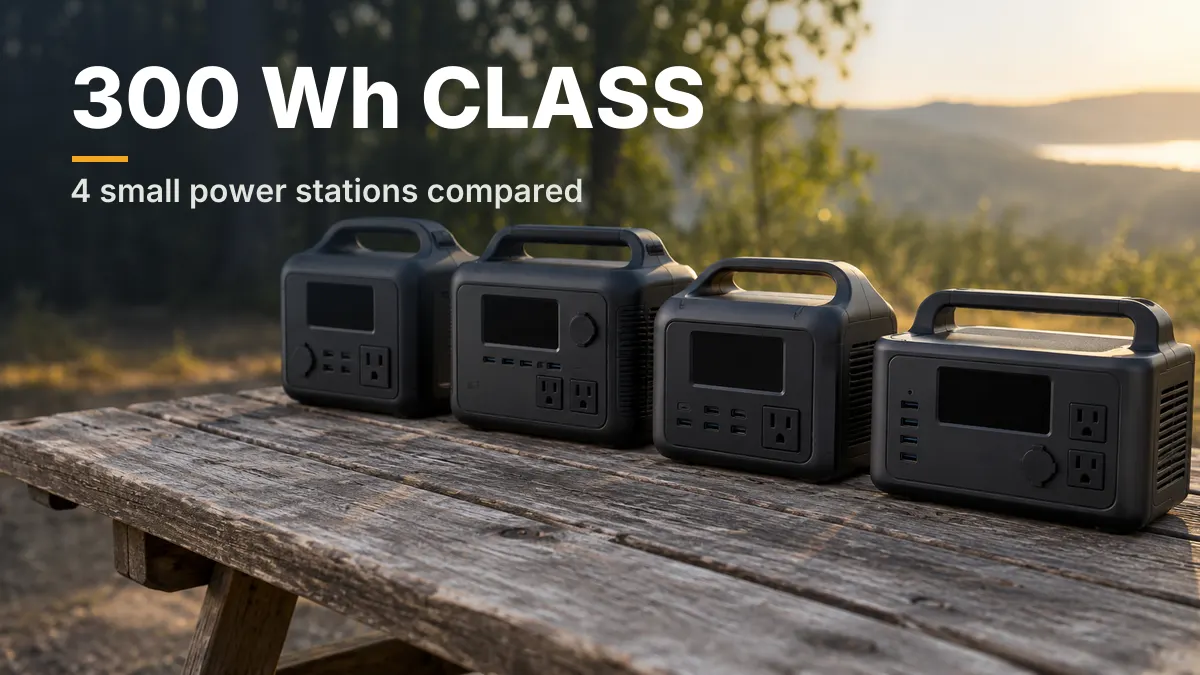
Four small 300 Wh class stations compared on their official specs: the EcoFlow RIVER 3 Plus, Anker SOLIX C300, Jackery Explorer 300 v2 and BLUETTI Elite 30 V2. They hold almost the same energy (286–288 Wh): about 4 hours of a 60 W laptop, a day of a Wi-Fi router, or one night of a CPAP with a heated humidifier. The real choice is output: the EcoFlow and the BLUETTI are rated for 600 W, the Anker and the Jackery for 300 W. The Jackery is the lightest at 8.2 lb.
How we compared: we don’t physically test products and no brand paid for a place on this page. Every figure comes from the manufacturer’s official U.S. product page, checked on October 29, 2026. There are no affiliate links on this page. See How We Research.
“300 watt” can mean two things
A “300 watt power station” can mean about 300 watt-hours of capacity or about 300 watts of output. All four below store about 300 Wh; two deliver 300 W and two deliver 600 W. Watts vs Watt-Hours explains the difference with a real spec sheet.
The specs side by side
| EcoFlow RIVER 3 Plus | Anker SOLIX C300 | Jackery Explorer 300 v2 | BLUETTI Elite 30 V2 | |
|---|---|---|---|---|
| Capacity | 286 Wh | 288 Wh | 288 Wh | 288 Wh |
| Rated AC output | 600 W | 300 W | 300 W | 600 W |
| Surge / boost | 1,200 W surge; 1,200 W X-Boost | 600 W with SurgePad | 600 W surge peak | 1,500 W “lifting power” |
| Weight | 10.4 lb | 9.1 lb | 8.16 lb | 9.48 lb |
| Wall charging | 380 W; 0–100% in 60 min | 80% in 50 min | 15 A input (time not clearly listed for this model) | 380 W; 80% in 45 min |
| Solar input | 220 W | 100 W (11–28 V) | Not clearly listed | 200 W (12–28 V, 10 A) |
| Strongest USB-C port | 100 W | 140 W (two-way) | 100 W (in and out) | 140 W |
| UPS switchover | Under 10 ms | Under 10 ms | 10 ms or less | 10 ms or less |
| Rated cycle life | 3,000 to 80% | Not listed on the page | 4,000 to 70%+ | 3,000+ to 80% |
| Expandable | Up to 858 Wh with an extra battery | No | Not listed | Not listed |
| Charging temperature | 32–113°F | Not listed | 32–113°F | 32–104°F |
| Warranty | Not found on the page | 5 years | 3 + 2 years | 5 years |
Specs checked on October 29, 2026 from each manufacturer’s U.S. product page. “SurgePad” (Anker), “X-Boost” (EcoFlow) and “lifting power” (BLUETTI) are each brand’s way of running some devices above the rated output, under conditions that vary by brand; they’re not the same as a higher rating. Check the manual. We don’t list prices: they change often.
What the differences mean
Capacity: a tie, and what it runs
With 286–288 Wh, these four deliver about 245 Wh from their AC outlets (our 0.85 allowance for inverter losses) or about 259 Wh from their 12 V and USB ports (0.90). In practice:
| Device | About how long |
|---|---|
| Laptop drawing 60 W | About 4 hours |
| Wi-Fi router drawing 10 W | About 24 hours |
| 12V fridge (Dometic CFX3 45 on a 90°F day, from the 12 V port) | About 21 hours |
| CPAP without humidifier (ResMed’s measurement, 56 Wh per night) | About 4.6 nights |
| CPAP with heated humidifier and heated tube (272 Wh per night) | Just under 1 night |
For your own CPAP settings, use our CPAP Battery Calculator. The fridge and CPAP figures come from our camping guide and CPAP guide. This class is for small electronics and short trips; for a fridge over a weekend, look at the 1,000 Wh class.
Output: 300 W or 600 W
This is the line that decides what you can plug in at all. 300 W covers laptops, phones, lights, a CPAP, a router or a small fan. 600 W adds room for things like a small TV and a laptop together, or a few devices at once. Neither runs a coffee maker, microwave or kettle at full power: those draw around 1,500 W (see our appliance guide).
Weight: all light, one lightest
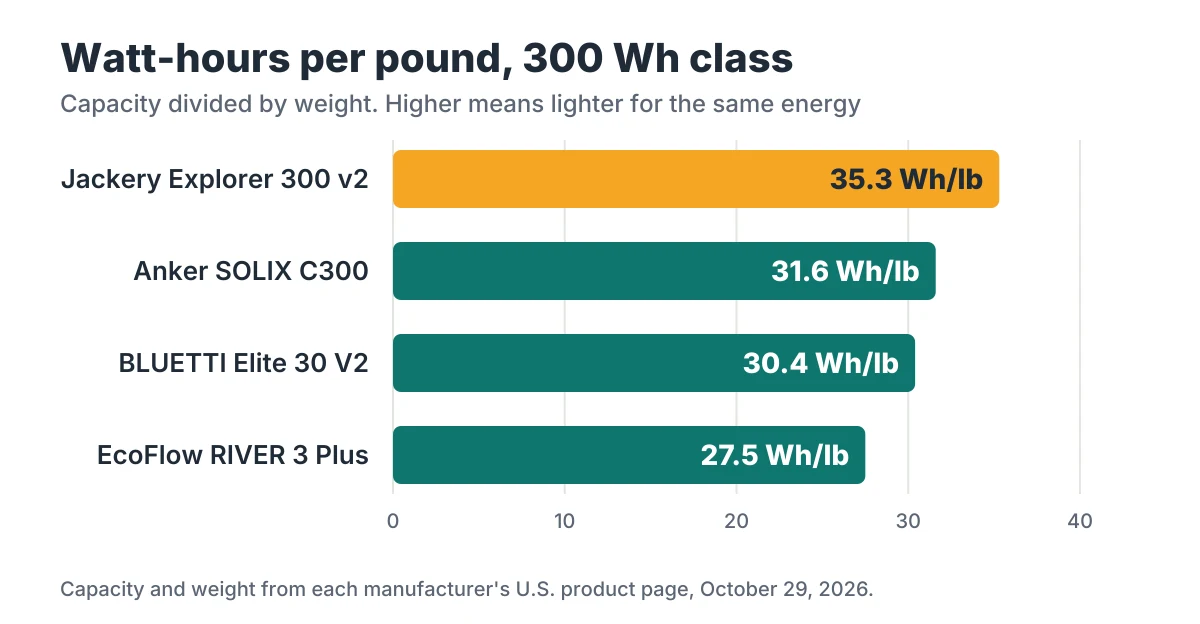
From 8.16 lb (Jackery) to 10.4 lb (EcoFlow). All four are easy to carry; the difference is about 2 lb.
Charging: about an hour from the wall
The EcoFlow lists a full charge in 60 minutes, the BLUETTI 80% in 45 minutes and the Anker 80% in 50 minutes. Jackery’s page lists a 15 A AC input for the 300 v2 but no clear charging time for this model. For solar, the EcoFlow accepts the most (220 W), the Anker the least (100 W). The Anker and the BLUETTI also accept only up to 28 V of panel voltage, so check the panel’s open-circuit voltage before connecting it. Our charging guide explains these limits.
USB-C: the port that matters most in this class
Many people use a small station mainly for laptops and phones. The Anker and the BLUETTI list a 140 W USB-C port; the EcoFlow and the Jackery 100 W. Charging a laptop from USB-C directly skips the inverter and its losses.
Cycle life
The EcoFlow and the BLUETTI are rated for 3,000 cycles to 80% of capacity, the Jackery 4,000 to 70%, and we didn’t find a rating on the Anker page. A rating to 70% is a lower bar than one to 80%, so the numbers aren’t directly comparable.
Which one fits which use
Based only on the specs above:
| If you care most about… | Look at |
|---|---|
| The lightest station | Jackery Explorer 300 v2: 8.16 lb |
| 600 W output and the most solar input | EcoFlow RIVER 3 Plus: 600 W, 220 W solar, expandable to 858 Wh |
| 600 W output and a 140 W USB-C port | BLUETTI Elite 30 V2 |
| A 140 W two-way USB-C port in a 300 W unit | Anker SOLIX C300 |
Taking one camping? Best Portable Power Station for Camping matches these and four larger models to each kind of trip. If you’re not sure this size is enough, start with What Size Portable Power Station Do I Need? or the runtime calculator.
Safety: Use the chargers and cables the manufacturer approves, keep the station within the temperatures in its manual and keep its vents clear. For a CPAP or other medical equipment, check the device maker’s guidance and talk to your doctor before relying on a battery.