Battery Powered Generator vs Gas Generator: Which to Buy
A battery powered generator (a portable power station) is quiet, has no exhaust, can be used indoors and costs far less per kWh when you recharge it from the grid: about 24 cents per kWh versus 74 cents to $1.16 for a small gas inverter generator at September 2026 U.S. prices. A gas generator wins when you need a lot of energy over several days without sun or grid, because you can keep refueling it. For short outages, camping and indoor use, choose battery; for long outages with high loads, gas (used outdoors only) or both.
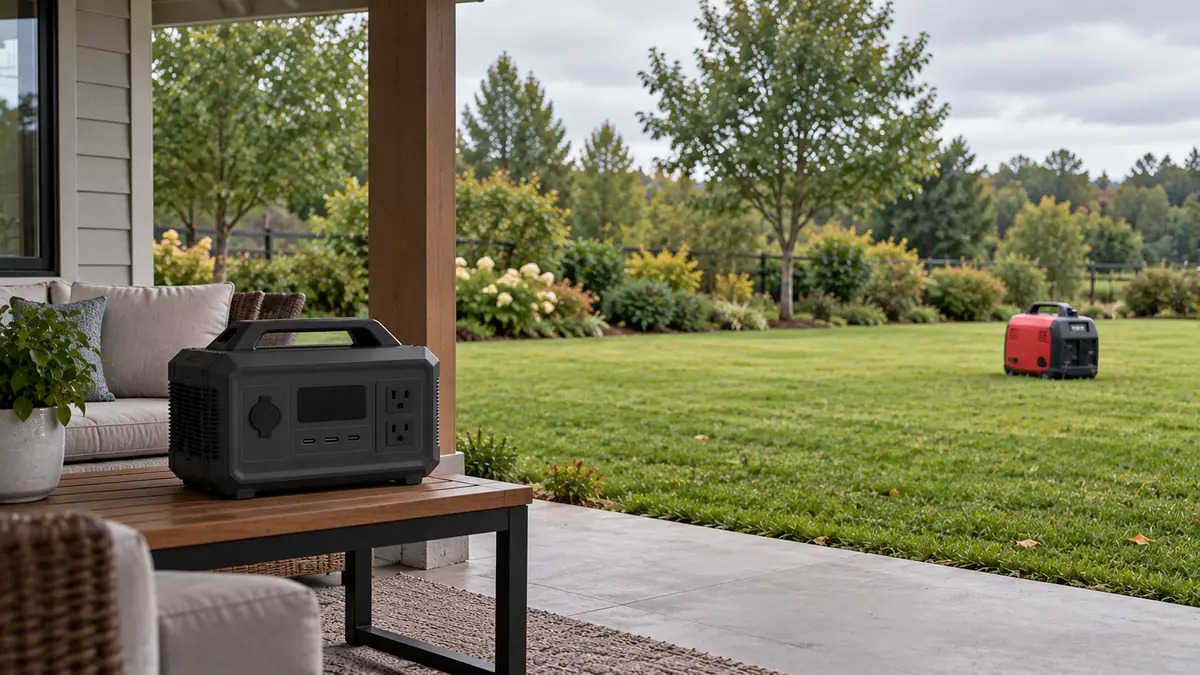
“Battery powered generator” and “solar generator” are marketing names for a portable power station: a large battery with an inverter and outlets. It doesn’t generate energy; it stores it. A gas generator burns fuel to produce electricity for as long as it has fuel. That single difference explains most of the comparison below.
Side by side
We compared a popular small gas inverter generator with two battery stations of similar output:
| Honda EU2200i (gas) | Anker SOLIX C1000 (battery) | EcoFlow RIVER 3 Plus (battery) | |
|---|---|---|---|
| Rated AC output | 1,800 W | 1,800 W | 600 W |
| Peak / surge | 2,200 W | 2,400 W | 1,200 W |
| Energy available | Unlimited while you refuel; 0.95 gal tank | 1,056 Wh per charge | 286 Wh per charge |
| Runtime | 3.2 h at 1,800 W; 8.1 h at ¼ load, per tank | Depends on load; see our calculator | Depends on load |
| Noise (manufacturer spec) | 62 dB at rated load, 53 dB at ¼ load | Not listed | Under 30 dB at 1.5 ft |
| Weight | 46.5 lb (dry) | 28.44 lb | 10.4 lb |
| Indoor use | Never | Yes, following the manual | Yes, following the manual |
Specs checked on September 30, 2026 from Honda’s official specifications and the manufacturers’ product pages. Noise figures are measured in different ways by each brand, so compare them only as a rough guide.
Energy: the key trade-off
One tank of the EU2200i delivers about 5.8 kWh at its rated 1,800 W (3.2 hours) or about 3.6 kWh at a quarter load (450 W for 8.1 hours). That single tank at quarter load is roughly four times the usable energy of a 1,056 Wh station (1,056 × 0.85 ≈ 900 Wh from the AC outlets). And with a gas generator, you can refill the tank and keep going.
A power station holds a fixed amount of energy. Once it’s empty, you need the grid, a car or solar panels to refill it, and that takes time. That’s why battery stations shine for short outages and daily cycles, and gas generators for long outages with no way to recharge. Use our runtime calculator to see how long a station lasts with your devices.
Cost per kWh
Gas generator: $4.465 per gallon ÷ 6.06 kWh per gallon (rated load) = $0.74 per kWh. At a quarter load: $4.465 ÷ 3.84 kWh per gallon = $1.16 per kWh.
Power station recharged from the grid: $0.1831 per kWh ÷ (0.90 charging × 0.85 inverter) = $0.24 per kWh delivered from the AC outlets.
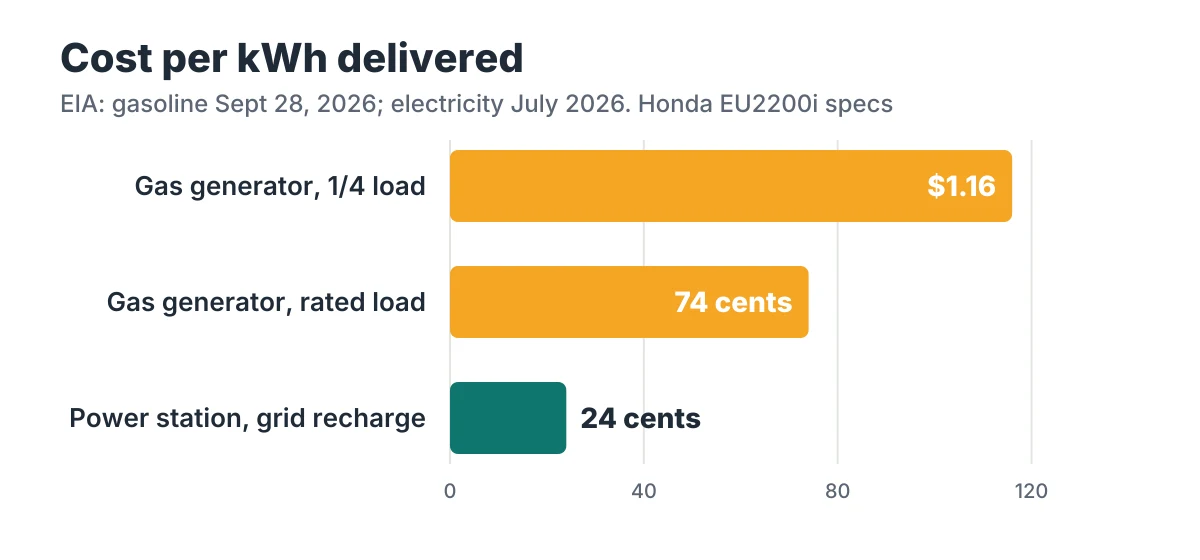
The gas figures use the U.S. average retail price of regular gasoline on September 28, 2026 ($4.465 per gallon) and Honda’s runtime specs. The grid figure uses the U.S. average residential electricity price for July 2026 (18.31 cents per kWh), both from the U.S. Energy Information Administration. The 0.90 and 0.85 are our planning assumptions for charging and inverter losses. Recharging from solar panels has no energy cost at all.
Two things this doesn’t include: the purchase price of each device, which varies widely, and the fact that during an outage you can’t recharge from the grid. In a multi-day outage, the real alternative to gas is solar, not the wall outlet.
Notice that the generator is less efficient at light loads: a quarter load costs more per kWh than a full load. Running a gas generator just to keep a fridge going is expensive per kWh; a power station, which only delivers what the fridge uses, handles that job well. Our refrigerator guide shows how long a station runs each type of fridge.
Noise
Honda lists the EU2200i at 53 dB at a quarter load and 62 dB at rated load. EcoFlow lists the RIVER 3 Plus at under 30 dB at 1.5 feet. A power station has no engine; the only sound comes from its cooling fan. That makes a big difference at campgrounds with generator quiet hours, and at night during an outage.
Safety: the biggest practical difference
Carbon monoxide: The U.S. Consumer Product Safety Commission warns never to use a portable generator inside a home, garage, basement, crawlspace, shed or other enclosed area, even with doors or windows open. Run it outdoors only, at least 20 feet from buildings, with the exhaust pointed away from windows, doors and vents. CO can kill in minutes.
A power station produces no exhaust, so it can sit next to your fridge or CPAP, following its manual’s temperature and ventilation instructions. For anything plugged into a home’s electrical panel, either device needs a transfer switch or inlet installed by a licensed electrician.
Maintenance
A gas engine needs regular care. Honda’s owner’s manual lists checking the oil before each use, periodic oil changes, air cleaner service and spark plug replacement, plus attention to the fuel system; check the manual for your model’s intervals. Stored gasoline also needs managing. A power station mostly needs to be kept charged and stored within the temperature range in its manual.
Which should you buy?
| Situation | Better fit |
|---|---|
| Short outages (hours to a day), fridge, internet, CPAP | Battery power station |
| Camping, van trips, quiet hours, indoor use | Battery power station |
| Multi-day outages with no sun, or high loads for many hours | Gas generator (outdoors only), or a large station plus solar |
| Occasional high-power tools on a job site | Gas generator, or a station rated above the tool’s watts |
Some people choose both: a station for quiet, indoor, everyday backup, and a generator outside for long outages. If you’d rather stay all-battery, 3000 Watt Solar Generators Compared lines up four stations that cover about two days of essentials. To size the battery side, start with our sizing guide. To see where our numbers come from, read How We Research.