Portable Power Station for RV: Sizing and What It Runs
A portable power station can run an RV’s everyday loads (fridge, lights, internet, laptops) for a day or more: our example day uses about 1,600 Wh, so plan on roughly 2,250 Wh per day between recharges. The air conditioner is the hard part: a standard 13,500 Btu rooftop unit draws up to about 1,860 VA, which empties a 2,048 Wh station in under an hour of compressor time. A station’s 30-amp RV outlet only delivers what its inverter is rated for, so check the watts, not the plug.
An RV already has its own electrical system: a 12V house battery, a converter that charges it, and a shore power cord for campground hookups. A portable power station doesn’t replace that system. It works as a second, movable source: a quiet substitute for a generator when you camp without hookups. This guide covers how much it can do, with the math shown.
How a power station connects to an RV
There are two plug-and-play ways to use one, and neither involves wiring:
- Plug devices straight into the station. This is the most efficient option for a laptop, a coffee maker or a CPAP.
- Plug the RV’s shore power cord into the station. The RV then behaves as if it were on a (small) campground hookup, and its outlets work. Some stations have a NEMA TT-30 outlet, the same 30-amp socket found on campground pedestals, so a 30-amp RV cord fits without an adapter.
Two things to know when the whole RV is plugged into the station:
- Your converter will try to charge the house battery from the station. That moves energy from one battery to another with losses along the way. Check your RV’s manual for how to switch the converter or charger off while you’re on the station.
- Everything left on in the RV counts. A water heater on electric mode or an air conditioner left on auto can drain the station while you’re away.
Safety: Use the RV’s own shore power cord, and only adapters approved for that use. Never use a cord with two male ends, and never connect a power station to the RV’s wiring or panel yourself: permanent connections, transfer switches and alternator chargers are jobs for a qualified RV technician or electrician. If you also carry a fuel generator, the U.S. Consumer Product Safety Commission warns never to run one inside or near an enclosed space; keep it outdoors, at least 20 feet away, with the exhaust pointed away from the RV. Carbon monoxide can kill in minutes.
What “30 amp” really means
A 30-amp RV hookup is 120 volts × 30 amps = 3,600 watts. A 50-amp hookup has two 50-amp, 120-volt lines, up to 12,000 watts. A power station with a TT-30 outlet does not automatically deliver 3,600 W: the limit is its inverter.
| BLUETTI AC200L | EcoFlow DELTA Pro 3 | |
|---|---|---|
| Capacity | 2,048 Wh | 4,096 Wh |
| Rated AC output | 2,400 W | 4,000 W |
| RV outlet | NEMA TT-30, 30 A | NEMA TT-30R, 30 A |
| What the TT-30 outlet can really deliver | Up to 2,400 W (20 A), two thirds of a 30-amp hookup | The full 3,600 W |
| Max solar input | 1,200 W | 2,600 W |
| Weight | 62.4 lb | 113.54 lb |
| Battery | LiFePO4, 3,000+ cycles to 80% | LFP, 4,000 cycles to 80% |
Specs checked on October 1, 2026 from the manufacturers’ pages. These are examples of stations with an RV outlet, not recommendations; 2000 Watt Power Stations Compared lines up four 2,000 Wh models, two of them with a TT-30 outlet. Weight matters in an RV: whatever the station weighs comes out of your cargo carrying capacity.
Can it run the RV air conditioner?
Sometimes, and not for long. Dometic’s installation manual for its rooftop units lists these figures for the FreshJet 3 13,500 Btu model (FJX3473M), at 115 V:
- Compressor: 13.6 A rated; fan: 2.6 A rated. Together, 16.2 A × 115 V = about 1,860 VA while the compressor runs. (Volt-amps are what the inverter has to supply; the real watts are somewhat lower.)
- Compressor locked-rotor current: 71 A. That’s the momentary worst case at startup, about 8,165 VA.
- Minimum generator size: 3.5 kW for one unit, according to Dometic’s general guideline.
Those numbers set two tests for a power station.
1. Can it start the compressor? Compare the station’s surge rating with that startup current, and treat Dometic’s 3.5 kW generator guideline as a warning: a station rated well below that may not start a standard unit at all. Ask the station’s manufacturer about your air conditioner model before you count on it.
2. How long can it run it? Using the same formula as our runtime calculator:
runtime (h) = battery Wh × 0.85 ÷ load
2,048 Wh station: 2,048 × 0.85 ÷ 1,860 = about 0.9 hours of compressor time
4,096 Wh station: 4,096 × 0.85 ÷ 1,860 = about 1.9 hours of compressor time
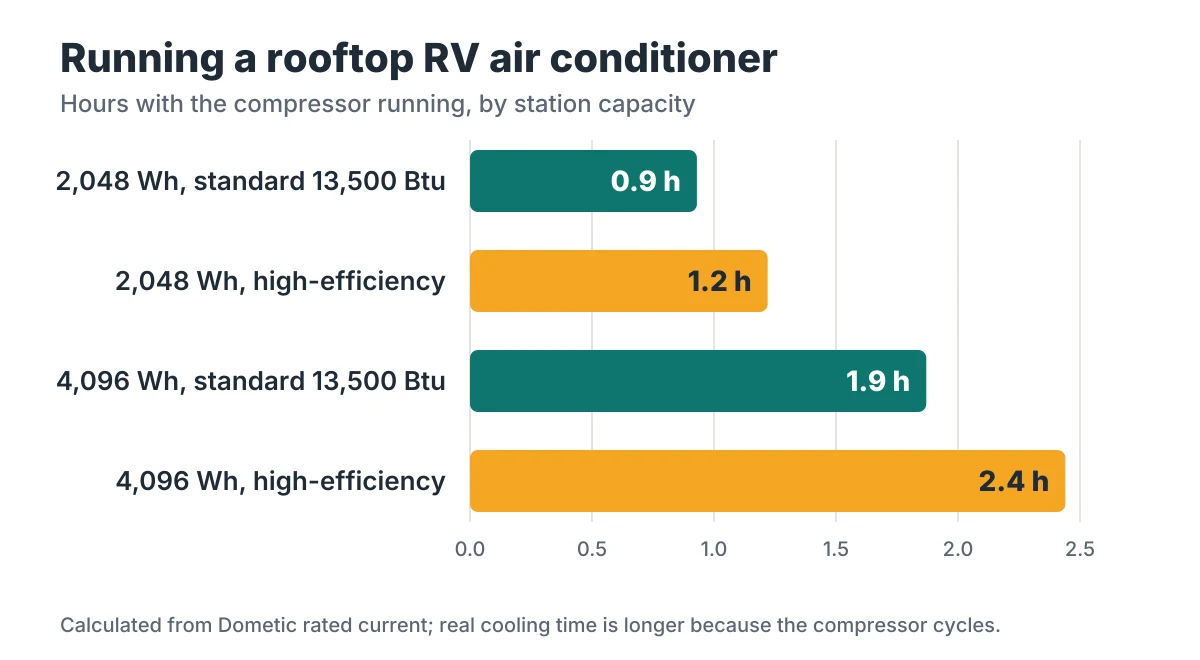
These are hours with the compressor running, calculated from rated current, so they are a conservative floor. The compressor cycles on and off, and how often depends on the heat, the sun and your RV’s insulation, so real hours of cooling will be longer. We don’t have a published figure for that, so we don’t estimate it.
A more efficient air conditioner changes the picture. The same Dometic manual lists the FreshJet 5 high-efficiency model (FJX5357MHE) at 8.8 A for the compressor and 3.6 A for the fan: about 1,430 VA, with a locked-rotor current of 55 A. That gives about 1.2 hours on 2,048 Wh and 2.4 hours on 4,096 Wh.
The practical conclusion: a power station can cool the RV for a lunch stop or take the edge off before bed. For air conditioning all afternoon without hookups, you need a much larger battery bank or a generator. Our battery vs gas generator comparison covers that trade-off.
An RV day without air conditioning
Without the air conditioner, the numbers are friendly. Here is an example day with the RV plugged into the station:
| Device | Watts | Hours/day | Wh/day |
|---|---|---|---|
| Residential-style top-freezer fridge (ENERGY STAR average) | 41.4 | 24 | 994 |
| Laptop (example: 60 W adapter) | 60 | 3 | 180 |
| Starlink Mini (upper end of its 25–40 W average) | 40 | 4 | 160 |
| LED interior lights (example: 30 W total) | 30 | 5 | 150 |
| Two phones charging (example: 20 W adapters) | 40 | 2 | 80 |
| Water pump (example: 60 W) | 60 | 0.5 | 30 |
| Total | 1,594 |
Battery energy used per day: 1,594 ÷ 0.85 = 1,875 Wh
With a 20% margin: 1,875 × 1.2 = about 2,250 Wh per day
So a 2,048 Wh station covers about one day of this list, and a 4,096 Wh station about two, before recharging. The 0.85 is our planning assumption for inverter losses and the 20% margin is our rule of thumb; neither is a measured value.
The fridge is the biggest line, and it depends on the type you have:
- Residential-style fridge: the figure above is the average of ENERGY STAR top-freezer models; see our refrigerator guide for other types.
- Absorption fridge (propane/electric): on propane, the cooling comes from the gas flame instead of your battery, which takes most of that 994 Wh off the list. In electric mode it uses a heating element, a heavy load for a battery.
- 12V compressor fridge: it runs from the RV’s house battery. Check its label or manual for consumption; the “rated current” on the label is the maximum, not the average.
Your own list will differ. Put it in the runtime calculator, or follow the steps in What Size Portable Power Station Do I Need?
How much solar do you need for an RV?
To put back what the example day uses (1,875 Wh), divide by your peak sun hours and by 0.77 for real-world losses, as in our Solar Panel Size Calculator:
| Location and season | Peak sun hours (angled panel) | Solar needed for 1,875 Wh/day |
|---|---|---|
| Phoenix, annual average | 6.68 | About 365 W |
| Denver, annual average | 5.85 | About 415 W |
| Phoenix, December | 5.53 | About 440 W |
| Seattle, July | 5.98 | About 405 W |
| Seattle, December | 1.65 | About 1,475 W |
Sun-hour data from the National Laboratory of the Rockies (NLR, formerly NREL). In most of the sunny season, 400 W of panels roughly keeps up with this example day. In a northern winter, solar alone won’t.
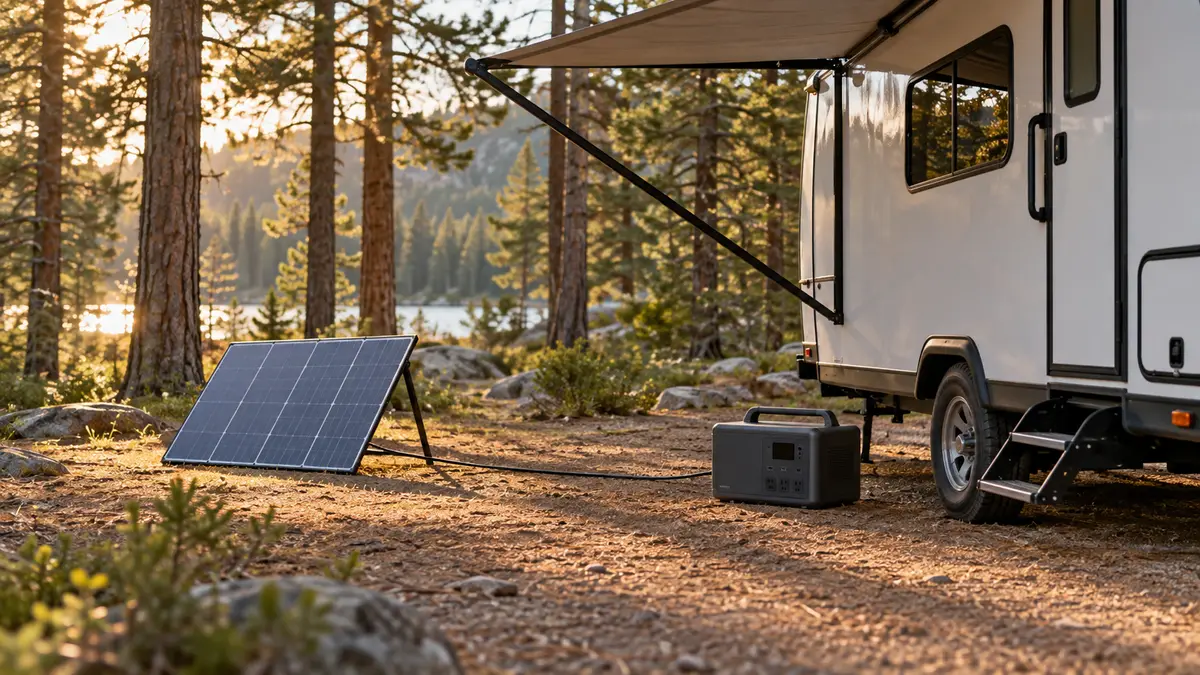
Portable panels have one real advantage in an RV: you can park in the shade and put the panels in the sun, angled toward it. Panels mounted flat on the roof can’t be aimed, and in winter that costs a lot: in Phoenix in December, a flat panel receives about 57% of what an angled one does (3.18 vs 5.53 peak sun hours). Check the station’s solar input limits before buying panels: the two stations above accept up to 1,200 W and 2,600 W.
Other ways to recharge on the road
For charging times and the limits of each method, see How to Charge a Portable Power Station.
- Campground hookups: on a night with shore power, the station recharges from an outlet like it does at home. The AC200L, for example, lists up to 2,400 W of AC input.
- Driving: many stations can charge from a vehicle’s 12V outlet; check the manual for the rate, which is usually modest. Faster alternator chargers exist, but they are wired into the vehicle and should be installed by a professional.
- A generator, during allowed hours: many campgrounds restrict generator use. Our camping guide has an example of those rules. One option is to run a generator during the allowed hours to refill the station, and use the station in silence the rest of the day.
What size for your kind of RV trip
| How you travel | Starting point |
|---|---|
| Mostly hookups, a night or two without | 1,000–2,000 Wh, enough for essentials overnight |
| Boondocking without air conditioning | About 2,250 Wh per day between recharges, plus roughly 400 W of solar in the sunny season |
| You want the air conditioner for an hour or two | 4,000 Wh or more, a rated output that can start your unit, and ideally a high-efficiency air conditioner |
| Air conditioning all day without hookups | Beyond a single portable station; consider a generator or a professionally installed system |
To see where our numbers come from, read How We Research.