How to Charge a Portable Power Station: Wall, Car, Solar
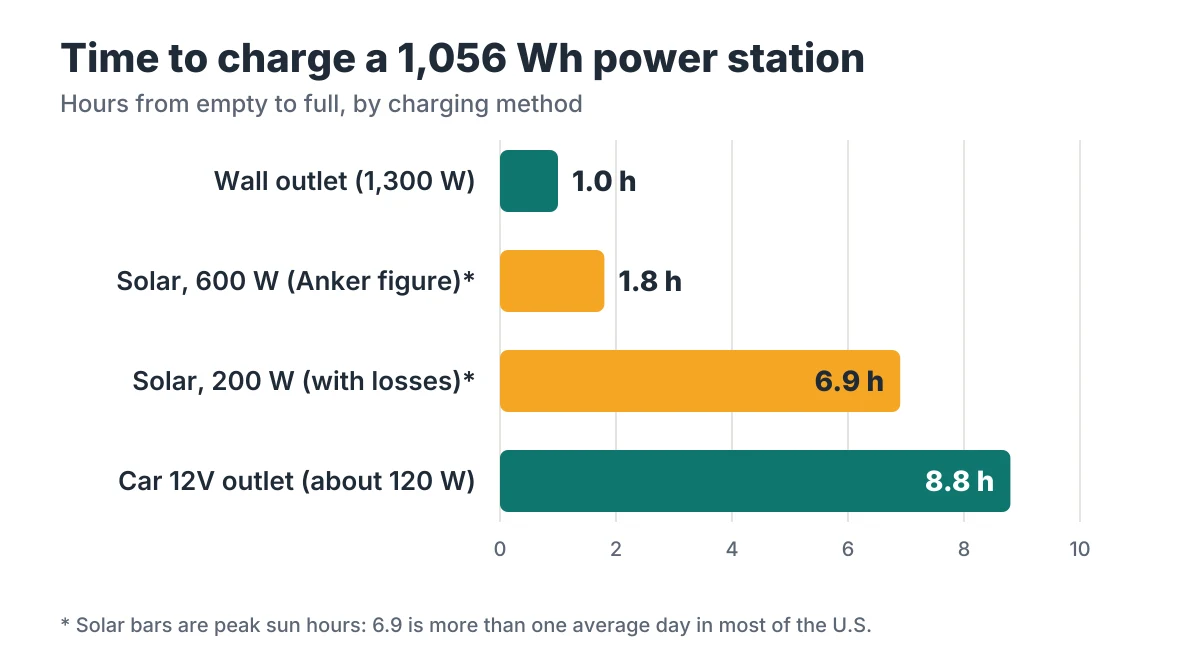
A portable power station charges three main ways. A wall outlet is the fastest: the models we checked refill in about an hour. Solar depends on your panels and your sun: 200 W of panels refill a 1,056 Wh station in roughly one sunny day. A car’s 12V outlet is the slowest, about 120 W at best, so the same station needs around 9 hours of driving. For any method, the rough math is hours = battery Wh ÷ charging watts.
Charging speed is limited by two things: how much power the source can give, and how much the station’s input accepts. The lower of the two wins. Here is how that plays out for each method, using the official specs of two stations as examples.
| EcoFlow RIVER 3 Plus (286 Wh) | Anker SOLIX C1000 (1,056 Wh) | |
|---|---|---|
| Wall (AC) input | 380 W; 0–100% in 60 min | 1,300 W max; 80% in 43 min, full in under an hour |
| Solar input | 220 W; as fast as 1.5 h | 600 W max, 11–60 V; 1.8 h at full input |
| Car input | 11–55 V; 0–100% in 3.3 h | 11–32 V at 10 A max (about 120 W from a 12V outlet) |
Specs checked on October 6, 2026 from the manufacturers’ pages. The times are the manufacturers’ own figures.
Charging from a wall outlet
This is the method to use before a trip or a storm. Plug the station’s AC cable into a household outlet and it charges at its rated AC input.
charging time (h) ≈ battery Wh ÷ AC input W
SOLIX C1000: 1,056 ÷ 1,300 = 0.8 h. Anker lists “under an hour”.
RIVER 3 Plus: 286 ÷ 380 = 0.75 h. EcoFlow lists 60 minutes.
The real time is a little longer than the division because charging slows down as the battery fills.
Do you need a separate power station charger? Usually not. Both stations in the table have the charger built in and ship with a plain AC cable. Check what’s in the box for your model before buying anything extra.
Mind the outlet when charging fast. A standard 15-amp household circuit supplies 15 A × 120 V = 1,800 W in total. The C1000 at 1,300 W takes most of that (about 10.8 A), so other loads on the same circuit can trip the breaker. Some larger stations go further: the BLUETTI AC200L lists up to 2,400 W of AC input, which is 20 A, more than a 15-amp circuit provides. Some stations let you lower the charging speed (Anker’s app has that setting for the C1000). Use it when you’re not in a hurry or the circuit is shared.
From a generator: it works like a wall outlet. EcoFlow lists the same 380 W input for generator charging on the RIVER 3 Plus. In a long outage, running a generator for a short time to refill a station can save fuel and noise compared with running it all day; see our battery vs gas generator comparison.
Charging from a car
A car’s 12V outlet (the cigarette lighter socket) is convenient and slow. The outlet works at about 12 volts, and the station limits the current it draws:
SOLIX C1000: Anker doesn’t list a car charging time. Its DC input accepts 10 A at most in the 11–32 V range, so from a 12 V outlet: 12 V × 10 A = about 120 W, and 1,056 Wh ÷ 120 W = at least 8.8 hours.
RIVER 3 Plus: EcoFlow lists 0–100% in 3.3 hours, an average of about 87 W (286 ÷ 3.3).
So car charging suits small stations and long drives. For a 1,000 Wh class station, a day on the road puts back only part of the battery.
Two practical points:
- Charge while the engine is running. With the engine off, a 12V outlet draws from the car’s starter battery. Check your vehicle’s manual: some outlets stay live with the ignition off.
- Alternator chargers are a different product. Some brands, Anker among them, sell alternator chargers for their stations. They connect to the vehicle’s electrical system and should be installed by a professional.
Charging from solar panels
Solar is the only way to recharge with no grid and no fuel. It’s also the method with the most limits to check. A station’s solar input has three:
- Maximum watts. Panels above the limit don’t charge faster. The RIVER 3 Plus accepts up to 220 W; the C1000 up to 600 W.
- Voltage range. The panels’ voltage has to stay inside the input’s window (11–60 V on the C1000). Going over the maximum can damage the station; treat it as a hard limit.
- Maximum current. Anker lists 10 A for 11–32 V and 12.5 A for 32–60 V on the C1000.
That third limit has a consequence that’s easy to miss. A typical folding panel works at about 20 V (an example value; check your panel’s label). At 20 V and 10 A, the C1000 takes in about 200 W, no matter how many of those panels you connect side by side. To use the full 600 W, the panel voltage has to be in the upper range: at 48 V and 12.5 A, the input reaches 600 W.
Series or parallel?
- Series (panel to panel, in a chain) adds the voltages. Two panels with a 24 V open-circuit voltage give 48 V; three give 72 V, over a 60 V limit.
- Parallel (with a branch connector) adds the currents and keeps the voltage. Two panels at 9 A each give 18 A, over a 10 A limit; the station only uses what its input allows.
The 24 V and 9 A are example values. Use the open-circuit voltage (Voc) on your panel’s label for the series check, and leave a margin: panel voltage rises in cold weather.
Connectors
Many solar panels end in MC4 connectors. Stations use different input ports: the C1000, for example, takes an XT-60 connector, so you need an MC4-to-XT-60 cable. Check the port on your station and whether the cable is included with the panel or the station.
How long does solar take?
Manufacturer times assume the full solar input in ideal sun. Anker’s 1.8 hours for the C1000 is 1,056 Wh ÷ 600 W. With fewer panels and real weather, use this formula from our Solar Panel Size Calculator:
days to recharge = station Wh ÷ (panel watts × peak sun hours × 0.77)
1,056 Wh station with 200 W of panels:
Phoenix, annual average (6.68 h): 1,056 ÷ (200 × 6.68 × 0.77) = about 1 day
Denver, annual average (5.85 h): about 1.2 days
Seattle, December (1.65 h): about 4.2 days
The 0.77 is our planning factor for real-world losses; the sun hours come from the National Laboratory of the Rockies (NLR, formerly NREL). For your state and month, use the calculator. To see what a panel really produces per day, read How Much Energy Does a Solar Panel Produce per Day?
Buying a power station with a solar panel
Bundles are convenient because the connector and voltage already match. If you choose the panel yourself, check three things against the station’s solar input: total watts at or under the maximum, Voc inside the voltage range (with a margin), and the right connector or adapter.
Can you use it while it charges?
Many stations can power devices while plugged into the wall, and some switch to battery automatically if the grid fails. The RIVER 3 Plus and the C1000 both list that UPS function. Check your manual to confirm that your model supports it.
One more detail from Anker’s page: the C1000 can’t charge from AC and solar at the same time. AC takes priority, and solar takes over when AC charging ends. Other models differ, so check yours.
Temperature and storage
- Don’t charge below freezing. Both stations in the table list charging only from 32°F (0°C) up. In winter, bring the station to a warmer place before charging it.
- Don’t store it empty. Anker’s guidance for the C1000, as an example: turn off the outputs when not in use, store it in a cool, dry place, recharge to 100% if it drops below 30%, and fully charge it once every 3 months. Follow the manual for your model.
Safety: Use the cables and adapters the manufacturer supplies or approves, and never exceed the station’s solar input voltage. Keep the station’s vents clear while it charges, and stop using any battery that is swollen, damaged or unusually hot. Don’t connect a power station or solar panels to your home’s or vehicle’s wiring yourself; that work belongs to a licensed electrician or qualified installer. If you charge from a fuel generator, run the generator outdoors only, at least 20 feet from buildings: carbon monoxide can kill in minutes.
Which method when?
| Situation | Best way to charge |
|---|---|
| Before a trip or a forecast storm | Wall outlet, the day before |
| Multi-day camping or boondocking | Solar, sized for your sun; see our camping guide |
| Road trip with a small station | Car outlet while driving |
| Road trip with a large station | Solar at camp or hookups; the car outlet only tops it up |
| Long outage without sun | Short generator runs, outdoors only |
Not sure how big a station you need in the first place? Start with What Size Portable Power Station Do I Need? To see where our numbers come from, read How We Research.