
Portable Power Station for CPAP: Runtime and Sizing
This guide covers power use and battery runtime only. It is not medical advice. Don’t change your therapy settings, including the humidifier, without talking to your doctor or equipment provider, and check your CPAP manufacturer’s instructions before powering it from any battery.
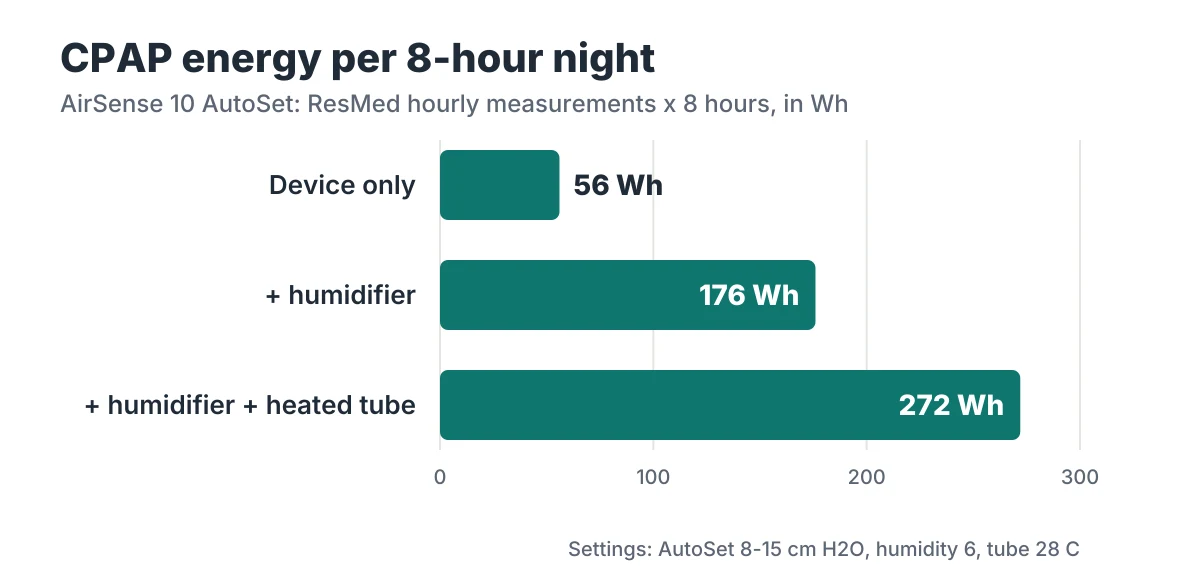
A CPAP uses little power on its own; the humidifier and heated tube are what drain the battery. In ResMed’s measurements, an AirSense 10 used about 7 W alone, 22 W with the humidifier and 34 W with the humidifier and heated tube. Over an 8-hour night that’s 56 to 272 Wh. A 1,056 Wh station powering the CPAP through a DC converter covers about 17 nights without humidification, but only about 3.5 nights with the humidifier and heated tube.
People buy a portable power station for a CPAP for two reasons: camping, and keeping therapy going during a power outage. In both cases the question is the same: how many nights will it last? The answer depends far more on your humidifier settings than on the CPAP itself.
How much power does a CPAP use?
ResMed has published power measurements for its Air10 devices, taken with a test setup at fixed settings (AutoSet mode, pressure 8–15 cm H2O, humidity setting 6, tube temperature 28°C). The figures are listed in watt-hours; we read them as energy per hour of use, which is the same as average watts.
| AirSense 10 AutoSet | Average watts | Wh per 8-hour night |
|---|---|---|
| Device only | 7 W | 56 Wh |
| Device + humidifier | 22 W | 176 Wh |
| Device + humidifier + heated tube (ClimateLineAir) | 34 W | 272 Wh |
For the newer AirSense 11, the user guide lists the 65 W power supply’s typical power consumption at 56.1 W and peak at 73.2 W. Treat that as an upper bound, not an average for your night: real use depends on your pressure, humidifier and tube settings, room temperature and mask leak.
Other brands publish different figures, and some don’t publish them at all. If your manual or your equipment provider can’t give you a number, a plug-in energy meter on a normal night at home will tell you exactly how many watt-hours you use.
How many nights will a power station last?
Estimated nights for the three ResMed scenarios, through a DC converter (90% efficiency, our planning assumption), with a full battery and no other devices:
| Station (capacity) | Device only (56 Wh) | + humidifier (176 Wh) | + humidifier + heated tube (272 Wh) |
|---|---|---|---|
| EcoFlow RIVER 3 Plus (286 Wh) | 4.6 nights | 1.5 nights | 0.9 nights |
| Anker SOLIX C1000 (1,056 Wh) | 17 nights | 5.4 nights | 3.5 nights |
| EcoFlow DELTA 3 Max Plus (2,048 Wh) | 33 nights | 10.5 nights | 6.8 nights |
Capacities checked on September 26, 2026 from the manufacturers’ pages. Through the AC outlet with the standard power supply, expect a bit less; we use 0.85 efficiency for AC. The formula:
nights = station Wh × efficiency ÷ (CPAP watts × hours per night)
Example: 1,056 Wh × 0.90 ÷ (22 W × 8 h) = 5.4 nights
These are best cases at ResMed’s test settings. Plan with a margin, especially for a medical device: we suggest assuming at least 20% fewer nights than the table shows (our rule of thumb, not a measured value). Use the runtime calculator with your own watts and hours.
DC or AC: how to connect it
ResMed strongly recommends DC-to-DC converters rather than DC-to-AC inverters when running its devices from a battery. In its battery guide, it lists the reasons: converters are more efficient, protect the device if leads are connected the wrong way, regulate the battery voltage, shut down before the battery is fully discharged and isolate the device electrically.
- DC (preferred by ResMed): use your manufacturer’s DC converter or DC cord. ResMed lists an Air10 DC/DC converter and an Air11 DC/DC converter; they plug into a 12V car-style outlet, which most power stations have. Check that your converter’s input range matches the station’s 12V port.
- AC: plug the CPAP’s normal power supply into the station’s AC outlet. ResMed’s guide asks for a pure sine wave inverter, certified (for example UL in the U.S.), and for its older devices recommends at least 300 W continuous and 500 W surge. The three stations in the table above all list more than that; also check that yours lists pure sine wave output.
Philips gives similar guidance for the DreamStation 2: use only a Philips Respironics DC power cord and battery adapter cable. When powering the device from a vehicle battery, ResMed warns not to start the engine (voltage spikes can damage the device), and Philips says not to use it while the engine is running.
Planning for a power outage
- Automatic switchover (UPS): some stations pass wall power through and switch to battery on their own when the grid fails. The RIVER 3 Plus and DELTA 3 Max Plus list under 10 ms; the SOLIX C1000 lists under 20 ms. With the CPAP plugged in through the station, an outage at night doesn’t interrupt it.
- Keep it charged: check the station’s manual for how to store it and how often to top it up, so it’s full when the outage comes.
- Know your number: measure one normal night at home before you need the backup.
Planning for camping
Camping adds cold nights and no wall outlet. Leave a bigger margin if you use the heated humidifier and tube in a cold tent, and remember that the stations we checked only charge above 32°F (0°C). Our camping guide covers recharging with solar and from the car, and our sizing guide shows how to add the CPAP to the rest of your devices.
Safety: Follow your CPAP manufacturer’s instructions for battery and DC use, and keep the station’s vents clear. Battery power stations don’t produce exhaust; fuel generators do. Never run a fuel generator indoors or near a tent or camper opening: carbon monoxide can kill in minutes. If you depend on your CPAP, talk to your doctor and equipment provider about a backup plan for power outages.
To see where our numbers come from, read How We Research.