2000 Watt Power Stations Compared: 4 Models, Real Specs
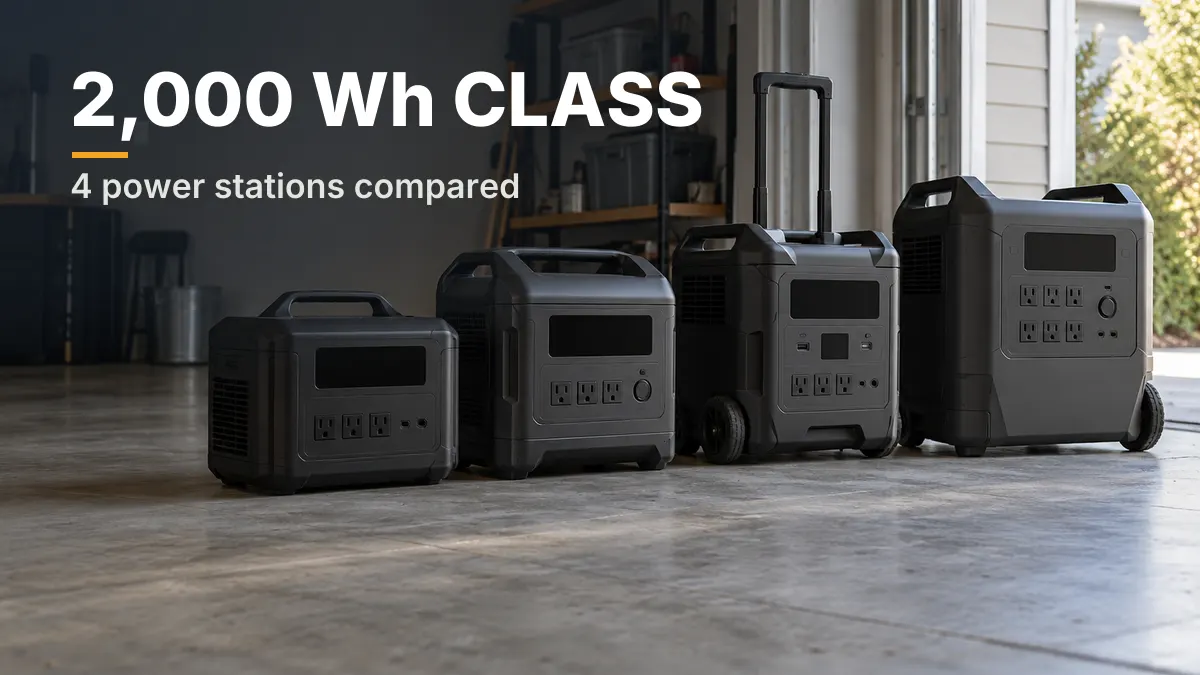
Four 2,000 Wh class stations compared on their official specs: the Anker SOLIX C2000 Gen 2, EcoFlow DELTA 3 Max Plus, Jackery Explorer 2000 v2 and BLUETTI AC200L. All four hold about 2,040–2,050 Wh, enough to keep a fridge, Wi-Fi, phones and lights going through a 24-hour outage. They differ in output (2,200 to 3,000 W), weight (39.5 to 62.4 lb), solar input (400 to 1,200 W) and whether they have a 30-amp RV outlet. The Jackery and the Anker are the lightest, the EcoFlow has the most output, and the BLUETTI takes the most solar but is by far the heaviest.
How we compared: we don’t physically test products and no brand paid for a place on this page. Every figure comes from the manufacturer’s official U.S. product page, checked on October 21, 2026. There are no affiliate links on this page. See How We Research.
What “2000 watt” means here
“2000 watt power station” usually refers to about 2,000 watt-hours of capacity, the size people buy for home backup, RVs and longer trips. All four stations below store about 2,000 Wh; their output in watts ranges from 2,200 to 3,000. If the two units blur together, Watts vs Watt-Hours explains the difference.
The specs side by side
| Anker SOLIX C2000 Gen 2 | EcoFlow DELTA 3 Max Plus | Jackery Explorer 2000 v2 | BLUETTI AC200L | |
|---|---|---|---|---|
| Capacity | 2,048 Wh | 2,048 Wh | 2,042 Wh | 2,048 Wh |
| Rated AC output | 2,400 W | 3,000 W | 2,200 W | 2,400 W |
| Surge / peak | 4,000 W | 6,000 W | 4,400 W | 7,200 W |
| Weight | 41 lb | 48.7 lb (22.1 kg) | 39.5 lb | 62.4 lb |
| Wall charging | 1,800 W; full in 88 min | 15 A input; 0–80% in 64 min | 15 A input; 1.75 h | 2,400 W; 1.5 h |
| Max solar input | 800 W (11–60 V) | 1,000 W | 400 W (11–60 V) | 1,200 W (12–145 V) |
| 30-amp RV outlet (TT-30) | Yes, 2,400 W max | Not listed | No | Yes, 2,400 W total |
| UPS switchover | 10 ms | Under 10 ms | 20 ms or less | 20 ms |
| Rated cycle life | 4,000 to 80% | Not listed on the page | 4,000 to 70%+ | 3,000+ to 80% |
| Expandable | Up to 4 kWh | Yes, with extra batteries | Not listed | Yes, with B210, B230 or B300 packs |
| Charging temperature | 32–104°F | 32–113°F | 32–113°F | Not listed (operating -4–104°F) |
| Warranty | 5 years | Up to 5 years (3 + 2 with app registration) | 3 + 2 years | 5 years |
Specs checked on October 21, 2026 from each manufacturer’s U.S. product page. Charging times and cycle ratings are each manufacturer’s own figures, measured under their own conditions. We don’t list prices: they change often.
What the differences mean
Capacity: a tie, and enough for a day of essentials
The four are within 6 Wh of each other. With our 0.85 allowance for inverter losses, each delivers about 1,740 Wh from its AC outlets: about 42 hours for a refrigerator averaging 41.4 W, or a full day of the outage essentials in our home backup guide (fridge, router, lamps and phones, about 1,415 Wh). If you need more, three of the four list expansion batteries.
Output: 2,200 W is plenty for most homes, 3,000 W for heavy appliances
Everything in our outage essentials list draws far less than 2,200 W. The higher ratings matter for things like a microwave (1,480 W in our appliance guide) running at the same time as a kettle or a coffee maker, or for power tools. The EcoFlow’s 3,000 W gives the most headroom. Surge (4,000 to 7,200 W) is the figure to check against the starting watts of a fridge, freezer or pump.
Weight: from easy to carry to two-person job
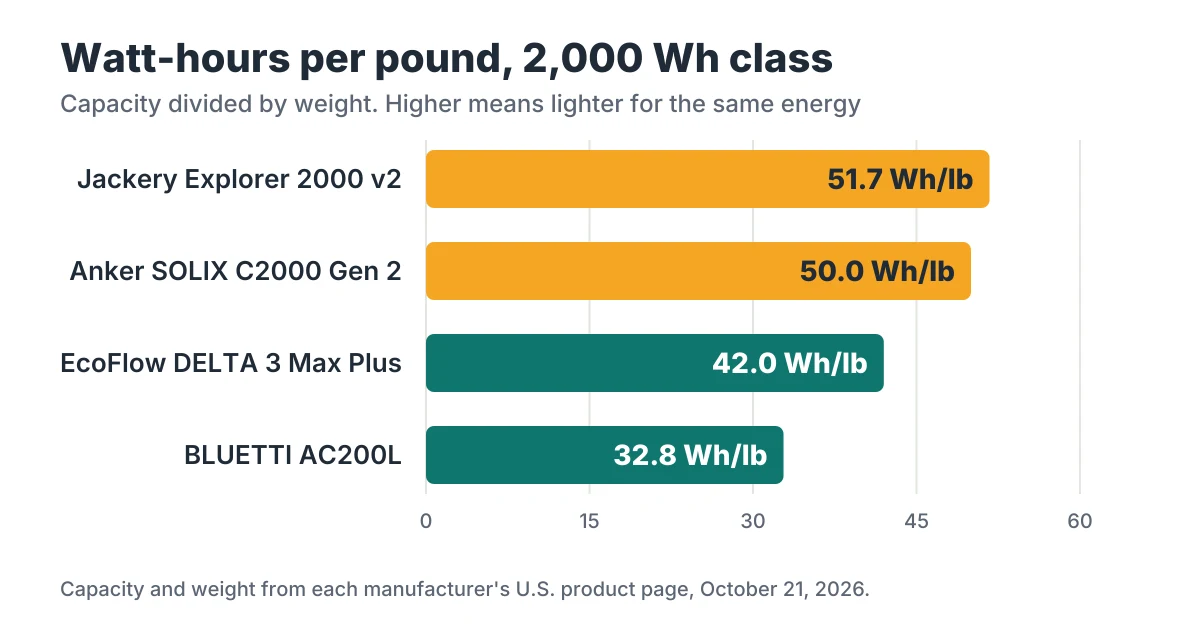
The Jackery (39.5 lb) and the Anker (41 lb) store about 50 Wh per pound. The BLUETTI stores about 33, at 62.4 lb: a 23 lb difference for the same energy. For a station that stays in a closet until the power goes out, weight matters less; for one you take camping or move between floors, it’s the first line to read.
Charging from the wall: watch the circuit
A standard 15-amp household circuit supplies 1,800 W. The Anker charges at 1,800 W, and the EcoFlow and Jackery list 15 A inputs, so each can take a whole circuit while charging at full speed. The BLUETTI’s 2,400 W input is 20 A, more than a 15-amp circuit provides. Use a lower charging setting when the circuit is shared; our charging guide explains the math.
Solar: the biggest spread
From 400 W on the Jackery to 1,200 W on the BLUETTI. The BLUETTI also accepts up to 145 V, which allows longer chains of panels in series; the Anker and the Jackery stop at 60 V. This only matters if you’ll own enough panels: to refill about 2,000 Wh in a day you need about 400 W of panels even in Phoenix (2,048 ÷ (6.68 × 0.77)). Our Solar Panel Size Calculator does that math for your location.
RV use: the TT-30 outlet
The Anker and the BLUETTI have a NEMA TT-30 outlet, the 30-amp RV socket, so a camper’s shore power cord plugs straight in. Both deliver up to 2,400 W through it, not the 3,600 W a full 30-amp hookup provides. Our RV guide explains what that means for an air conditioner.
Home backup: UPS and cycle life
All four list a UPS function: the Anker and the EcoFlow switch in 10 ms or less, the Jackery and the BLUETTI in 20 ms or less. For cycle life, two are rated to 80% of capacity (Anker 4,000 cycles, BLUETTI 3,000+), the Jackery to 70% (4,000 cycles), and we didn’t find a cycle rating on the EcoFlow page. A rating to 70% is a lower bar than one to 80%, so the numbers aren’t directly comparable.
Which one fits which use
Based only on the specs above:
| If you care most about… | Look at |
|---|---|
| Carrying it | Jackery Explorer 2000 v2 (39.5 lb) or Anker SOLIX C2000 Gen 2 (41 lb) |
| Running several big appliances at once | EcoFlow DELTA 3 Max Plus: 3,000 W rated |
| An RV hookup outlet in a lighter unit | Anker SOLIX C2000 Gen 2: TT-30, 41 lb |
| Lots of solar, long panel chains | BLUETTI AC200L: 1,200 W, up to 145 V, but 62.4 lb |
Make sure 2,000 Wh is the right size before you compare models: our sizing guide and runtime calculator work it out from your own devices. For smaller needs, see 1000 Watt Power Stations Compared; for multi-day backup or 240 V, see 3000 Watt Solar Generators Compared.
Safety: Plug devices or an RV’s shore cord directly into the station. Don’t connect a power station to your home’s electrical panel or wiring yourself; that requires a transfer switch or inlet installed by a licensed electrician. Keep the station within the temperatures in its manual and keep its vents clear.