
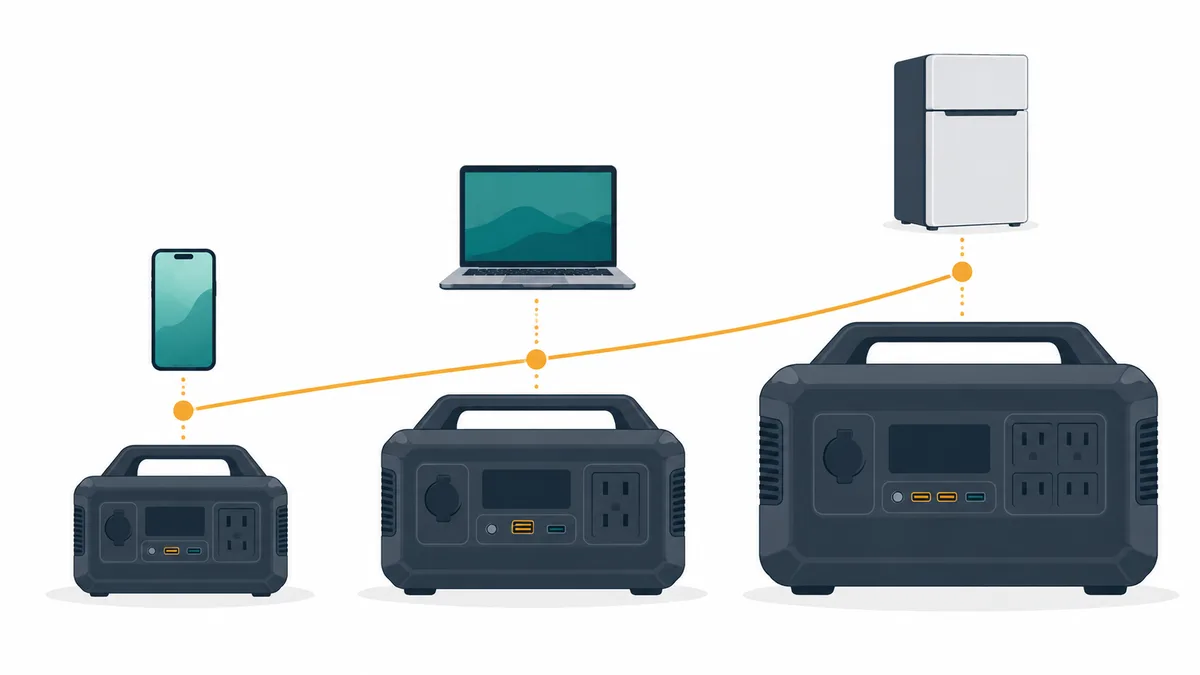
What Size Portable Power Station Do I Need? (With Math)
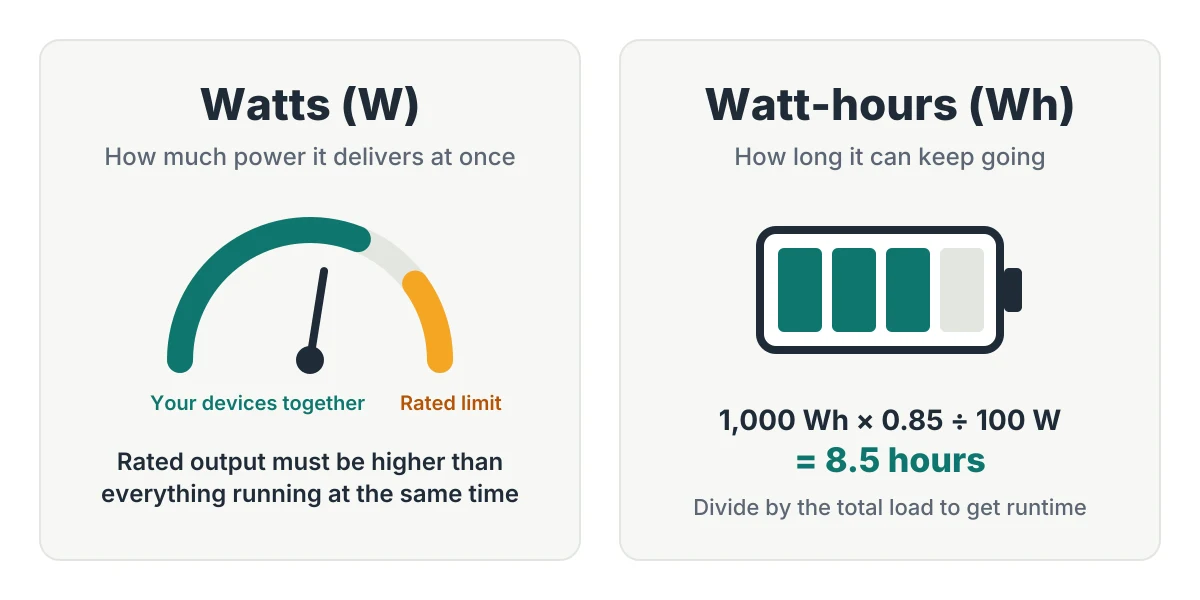
You need two numbers, not one. Output (watts) must be higher than everything you plug in at the same time, including the startup surge of fridges and pumps. Capacity (watt-hours) must cover the energy you use between recharges: add up watts × hours for each device, divide by 0.85, and keep a margin. In our examples below, a weekend of small electronics and satellite internet needs about 1,000 Wh, and keeping a fridge and internet running through a one-day outage needs about 2,000 Wh.
- Step 1: List your devices and their watts
- Step 2: Check output (watts) and surge
- Step 3: Add up watt-hours per day
- Step 4: Add a margin
- Worked example 1: Weekend camping
- Worked example 2: A one-day power outage
- Worked example 3: A coffee maker on a road trip
- Quick guide by use
- What about recharging?
Most sizing mistakes come from mixing up those two numbers. A station can have plenty of stored energy and still refuse to run a coffee maker, or run a heater easily but only for 20 minutes. This guide walks through the math in four steps and shows three worked examples.
Step 1: List your devices and their watts
Write down everything you want to power and how many watts each one draws. You’ll find the figure on the device’s label, its power adapter or its manual. If the label only shows amps, multiply by the voltage: most U.S. household devices use 120 V, so 0.5 A × 120 V = 60 W.
The watts printed on a label are usually the device’s maximum draw, according to the U.S. Department of Energy. That makes a label-based estimate conservative, which is fine for sizing.
For fridges, freezers and TVs, the yellow EnergyGuide label gives a better number: estimated energy use in kWh per year. Divide by 8.76 to get average watts. A fridge rated 450 kWh/year averages about 51 W, even though its compressor draws much more while it’s running.
Step 2: Check output (watts) and surge
Add up the watts of everything that will run at the same time. The station’s rated continuous output has to be higher than that total. If it isn’t, the station shuts off or refuses to power the load, no matter how full the battery is.
Motors and compressors (fridges, freezers, pumps, some power tools) pull several times their running watts for a moment when they start. That spike has to fit under the station’s surge rating. Check the device’s manual for its starting watts.
Here is what that looks like on real stations:
| Model | Capacity | Rated AC output | Surge |
|---|---|---|---|
| EcoFlow RIVER 3 Plus | 286 Wh | 600 W | 1,200 W |
| Anker SOLIX C1000 | 1,056 Wh | 1,800 W | 2,400 W |
| EcoFlow DELTA 3 Max Plus | 2,048 Wh | 3,000 W | 6,000 W |
Specs checked on September 26, 2026 from the manufacturer’s page. These are examples to show the range of sizes, not recommendations.
Step 3: Add up watt-hours per day
For each device, multiply its watts by the hours you’ll use it per day. Add the results to get your daily watt-hours. Then multiply by the number of days you need to go without recharging.
capacity needed (Wh) = Σ (watts × hours per day) × days ÷ 0.85
The 0.85 accounts for the energy lost when the station’s inverter converts battery power into AC for your devices. It’s the same planning assumption we use in our Power Station Runtime Calculator. If you’ll mostly use DC or USB ports, losses are lower.
Step 4: Add a margin
Your result assumes a new battery, mild temperatures and devices that behave exactly like their labels. Real life is messier: batteries lose capacity with age, temperatures outside the range in the manual affect performance, and you’ll probably plug in something you didn’t plan for. We suggest adding at least 20% on top of the result. That figure is our rule of thumb, not a measured value.
If you can recharge every day, from solar panels or a car, you can size for one day plus a margin instead of the whole trip.
Worked example 1: Weekend camping
Two days without recharging, with satellite internet for a few hours a day.
| Device | Watts | Hours/day | Wh/day |
|---|---|---|---|
| Starlink Mini (upper end of its 25–40 W average) | 40 | 4 | 160 |
| Laptop charging (60 W adapter maximum) | 60 | 2 | 120 |
| LED camp lights (example label value) | 10 | 5 | 50 |
| Total | 110 | 330 |
330 Wh × 2 days ÷ 0.85 = 776 Wh, plus 20% = 932 Wh
Result: a station of about 1,000 Wh. Output is not a problem here: everything together draws 110 W, which even the smallest station in the table handles. The 286 Wh RIVER 3 Plus would run the same load for about 2.2 hours (286 × 0.85 ÷ 110). That’s not even one day of this list: 330 Wh per day against about 243 Wh usable (286 × 0.85).
Worked example 2: A one-day power outage
Keep a full-size fridge, the Wi-Fi router and two phones going for 24 hours.
| Device | Watts | Hours/day | Wh/day |
|---|---|---|---|
| Fridge rated 450 kWh/year (average) | 51.4 | 24 | 1,233 |
| Wi-Fi router (example label value) | 10 | 24 | 240 |
| Two phones charging (example: 20 W adapters) | 40 | 2 | 80 |
| Total | 1,553 |
1,553 Wh ÷ 0.85 = 1,827 Wh, plus 20% = 2,192 Wh
Result: plan for about 2,000 Wh or more. For output, check the fridge’s startup surge in its manual and compare it with the station’s surge rating; our refrigerator guide explains how. A 1,056 Wh station like the Anker SOLIX C1000 would keep the fridge and router going for roughly 14.6 hours. The 2,048 Wh DELTA 3 Max Plus would last about 28 hours, before the margin.
Safety: Plug the fridge straight into the station. Don’t connect a portable power station to your home’s electrical panel or wiring yourself; that requires a transfer switch or inlet installed by a licensed electrician. And never run a fuel-burning generator indoors or in a garage: it produces carbon monoxide.
Worked example 3: A coffee maker on a road trip
A 1,000 W coffee maker (example label value) running for 10 minutes uses little energy:
1,000 W × 10 min ÷ 60 = 167 Wh, ÷ 0.85 = 196 Wh
The 286 Wh RIVER 3 Plus has enough stored energy for that. But its rated AC output is 600 W, so it can’t run a 1,000 W appliance normally. Some models list a boost mode (the RIVER 3 Plus lists X-Boost up to 1,200 W); check the manual to see which appliances it supports and how they behave. Result: for high-wattage appliances, output decides the size, not capacity. You’d need a station rated above 1,000 W, like the 1,800 W SOLIX C1000.
Quick guide by use
Based on the method above and the examples in this guide:
| What you want to run | Look at first | Starting point |
|---|---|---|
| The devices from example 1, for a single day | Capacity | About 500 Wh (330 Wh ÷ 0.85 + 20%) |
| A weekend of small electronics and satellite internet | Capacity | About 1,000 Wh |
| A fridge and internet through a one-day outage | Capacity and surge | About 2,000 Wh |
| Coffee makers, kettles, microwaves, power tools | Output (W) | Rated output above the appliance’s watts |
These are starting points for the loads in our examples. Your own list of devices is what decides the size. Run it through the runtime calculator to check before you buy.
What about recharging?
Capacity only covers the time between recharges. If you’ll recharge with solar panels, the panels’ real output depends on sunlight, season and angle, so size the battery for at least one full day on its own. Our Solar Panel Size Calculator shows how many panel watts you need in your state, month by month. To see where our numbers come from, read How We Research.